

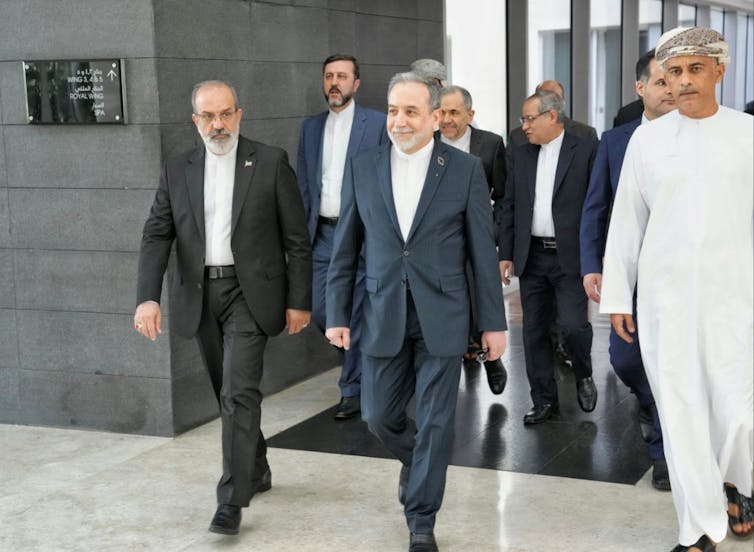
When Iranian and US officials met for talks in the Omani capital of Muscat on February 6, many journalists and analysts were speculating as to whether diplomacy will fail and whether war will inevitably follow. But that framing misses the deeper reality of this moment. The more important question is why both sides have returned to the negotiating table at all, despite years of hostility, sanctions, proxy conflict and open threats.
The anxiety that has surrounded the talks is understandable. Washington warned its citizens to leave Iran hours before the talks took place, fuelling speculation about military strikes. US officials outlined sweeping demands that go far beyond wanting to curb Iran’s ambition to possess nuclear weapons. And recent history offers no shortage of examples where negotiations have collapsed into violence.
But treating the talks as a countdown to conflict misunderstands diplomacy and the balance of power in the Middle East today. Negotiations are not a single test of resolve, nor a one-off gamble on peace. The talks in Oman were not a final reckoning but an opening move. They reflect a shared recognition in Washington and Tehran that 15 years of coercion, pressure and force have failed to produce decisive outcomes, and that escalation now would be vastly more dangerous than before.
Iranian Foreign Ministry / EPA
As diplomacy scholar Geoffrey Berridge has long argued, the first stage of any serious diplomatic process is the establishment of common ground on key points. Only once this groundwork is laid can substantive negotiations begin. The talks in Oman should thus be understood as an opening phase rather than a decisive round.
The purpose was to clarify positions, communicate red lines and test whether a workable diplomatic pathway exists. Iranian officials described the atmosphere as constructive, noting that the two sides communicated their concerns and views through their host, Oman’s foreign minister Badr Albusaidi. This is precisely how diplomacy begins, not how it ends, and Iranian and US officials have both subsequently called for talks to continue.
For Tehran, engaging a US delegation in talks is significant. Iran has consistently sought recognition as a legitimate regional player rather than a state to be coerced or isolated. The willingness of Iran’s foreign minister, Abbas Araghchi, to attend the talks personally signals how seriously Iran views this moment and how invested it is in a diplomatic outcome that confers mutual respect.
For Washington, the incentives are equally clear. Over the past 15 years, the US has applied nearly every available tool of pressure against Iran. These have included sanctions, cyber operations, targeted strikes, the killing of senior Iranian figures, the degradation of Iran-aligned groups across the region and direct support for Israel during its brief 2025 war with Iran. Yet none of this has delivered regime change, capitulation or lasting regional stability.
Sanctions have devastated the Iranian economy and Tehran’s regional network has been weakened. Hezbollah has faced mounting pressure and economic strain in Lebanon, Hamas has been severely battered in Gaza and Houthi forces in Yemen have been constrained by international military patrols. Even so, Iran’s core political system remains intact.
Domestic unrest has also failed to produce collapse. Recent protests, met with intense and often violent repression, did not topple a regime that has been deliberately built to survive external pressure since 1979. This highlights a central paradox: Iran may be weaker than at any point in recent decades, but it is not as fragile as many external observers assume.
Washington’s negotiating position
Statements from US officials insisting that talks should encompass Iran’s ballistic missile programme, its regional alliances and its domestic governance represent the high end of any negotiating position.
This is not unusual. In diplomacy, opening demands are often maximalist by design. They are intended to create leverage rather than define an achievable endpoint, something the US president, Donald Trump, is known for. The risk lies in treating these demands as simultaneously attainable.
From Tehran’s perspective, these issues are not equivalent. Iran has consistently signalled that nuclear weapons are the only area it is prepared to engage meaningfully over. This is because its nuclear programme has already been internationalised through treaties, inspections and prior agreements.
Iran’s leadership has also repeatedly pointed to Supreme Leader Ayatollah Ali Khamenei’s religious decree declaring the production and use of nuclear weapons forbidden under Islamic law. Western policymakers are sceptical of the decree’s legal enforceability. But it nonetheless provides Tehran with an ideological framework that allows nuclear restraint to be framed domestically as principled rather than imposed from outside.
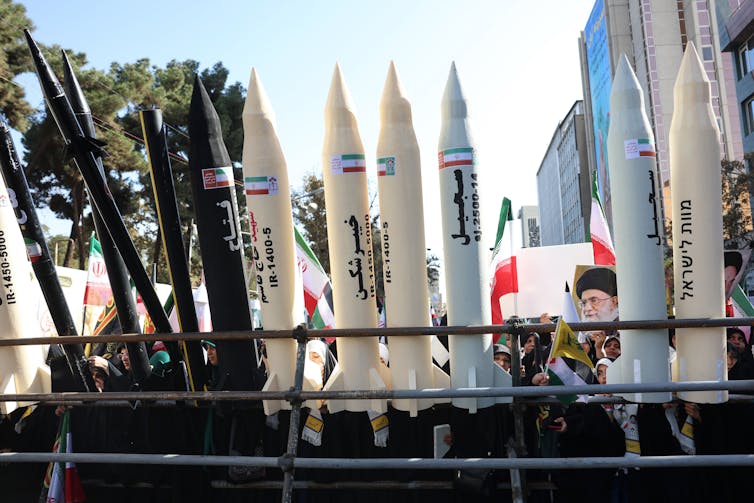
In contrast, Iran views the existence of its ballistic missile arsenal as non-negotiable. In a region where Iran faces nuclear-armed adversaries and an overwhelming conventional military imbalance, missile capabilities are central to its deterrence strategy. Likewise, Iran’s regional alliances are not simply tools of influence. They are an extension of this defensive posture that has been shaped by decades of war, sanctions and isolation.
Domestic governance is even more sensitive. No Iranian negotiating team could accept external constraints on how the Islamic Republic governs itself without calling into question the legitimacy of the system they represent. Attempts to fuse diplomacy with demands for internal political reform are therefore perceived not as bargaining positions, but as existential threats.
Bundling nuclear limits, regional retrenchment and internal transformation into a single negotiating framework thus risks overreach. Progress is far more likely through sequencing: addressing the nuclear issue first, building confidence through verification and reciprocity, and only then exploring narrower forms of deescalation elsewhere. Understanding this helps explain why talks can proceed despite sharp rhetoric and military signalling.
Abedin Taherkenareh / EPA
Mutual risk, mutual opportunity
Araghchi’s description of the talks in Muscat as a “good beginning” where both sides were able to convey their interests and concerns, as well as his subsequent expression of hope for further negotiations, suggests that diplomacy remains preferable for Iran. The same probably applies for the US.
Military intervention has rarely produced stable outcomes in recent Middle Eastern and North African history. The removal of Saddam Hussein in Iraq, Muammar Gaddafi in Libya and the collapse of state authority in Syria did not bring immediate peace or genuine democracy. They produced power vacuums, proxy wars, mass displacement and chronic instability.
Iran is larger, more institutionalised and more deeply embedded in regional dynamics than any of those cases. A conflict involving the Islamic Republic would be longer, more destructive and far harder to contain.
The real danger is not that diplomacy between Iran and the US will fail, but that it will be dismissed too quickly. Negotiations are incremental, often frustrating and rarely linear. But in this case, they may reflect the only viable strategy available to both sides.
Iran avoids an unwinnable war. The US avoids another Middle Eastern quagmire. And the region gains a fragile but vital opportunity to move away from permanent crisis. In that sense, the talks themselves may already represent the most meaningful progress possible.