

Many Kurdish people will be feeling betrayed by the US after the Syrian army, backed by the US and armed by Turkey, launched an offensive against the Kurdish-led Syrian Democratic Forces (SDF) in early January. The SDF has long been hailed as the west’s most effective partner against the Islamic State (IS) terrorist organisation.
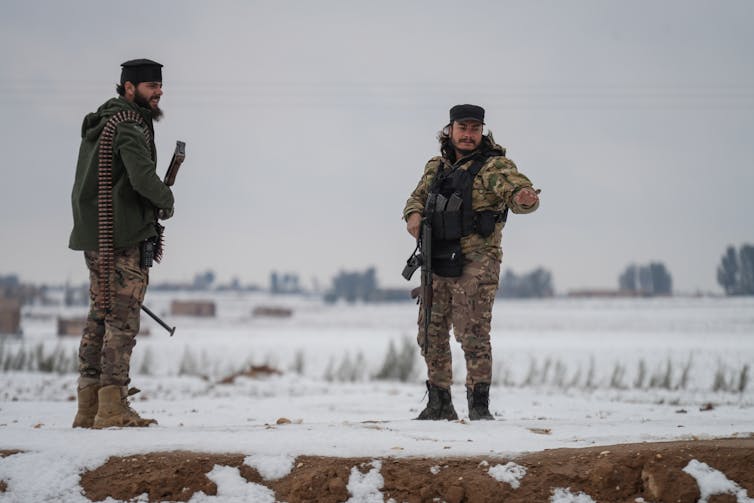
Led by Ahmed al-Sharaa, the Syrian president who was formerly an al-Qaeda commander, the army initially targeted two Kurdish neighbourhoods in the city of Aleppo. Government forces then captured the SDF-held provinces of Deir ez-Zor and Raqqa further east before advancing on the Kurdish-majority regions of Hasakah and Kobani in the north-east corner of the country.
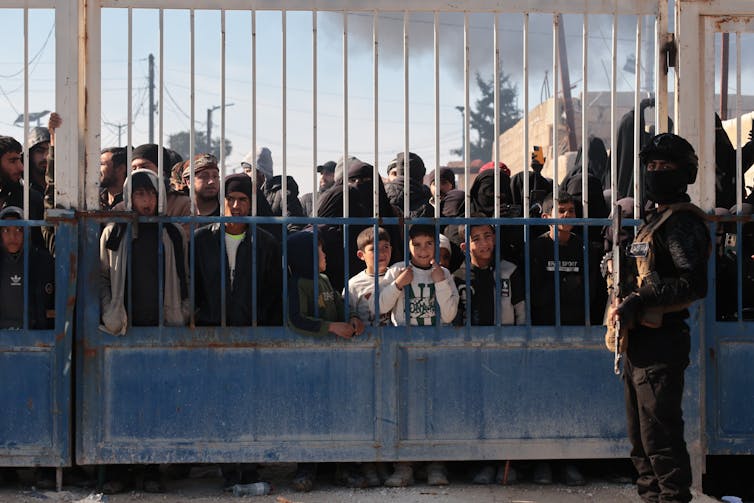
The Syrian army and the SDF are currently observing a fragile 15-day ceasefire, brokered by the US. But according to the UN, at least 134,000 Kurds have already been displaced. And many Kurdish civilians fear a repeat of the 2025 sectarian mass killings and widespread abuse against Syria’s Alevi and Druze communities.
Kobani, a city famous as the site of heroic Kurdish resistance against IS in 2014, is under siege with its water and electricity supplies cut off. And Elham Ahmad, a senior Kurdish official, claims the Syrian army has already executed hundreds of captured Kurdish fighters and civilians. She has characterised the actions of the state as a “war of extermination” against the Kurds.
Ahmad Fallaha / EPA
Abandoning Kurdish allies
The geopolitical fulcrum of this upheaval is US regional strategy. Shortly after becoming Nato’s first secretary general in 1952, Lord Hastings Ismay said the organisation’s purpose was “to keep the Soviet Union out, the Americans in and the Germans down”. In a similar vein, the US strategy in Syria arguably seeks to keep America afar, Iran out and Israel and Turkey apart.
In line with the Trump administration’s 2025 national security strategy, Washington has sought to block Iranian influence in the Middle East. Keen to shift the burden for overseeing the region’s security away from the US, it has also looked to withdraw US forces from Syria after al-Sharaa’s Hay’at Tahrir al-Sham (HTS) coalition of Turkey-backed Islamist groups toppled longtime dictator Bashar al-Assad in December 2024.
A strong HTS-led Sunni Muslim state that is hostile to Iran and its Shia proxies in Iraq and Lebanon, under Turkish tutelage and supported by the Gulf states, was deemed the best option. Yet diverging Israeli and Turkish priorities have complicated this approach.
Israel viewed al-Sharaa’s al-Qaeda past and the inclusion of foreign jihadist fighters in the Syrian military as grave security threats. This helps explain why, immediately after Assad’s fall, Israel destroyed much of Syria’s strategic military infrastructure to prevent it from falling into Islamist hands.
Turkey, meanwhile, has long regarded the autonomy of Syrian Kurds (effective since 2012) as a threat, given the decades-long struggle of its own large Kurdish population for political and cultural rights. Washington sought to square these competing interests through a two-pronged approach.
First, it pushed Syria and Israel towards negotiating a security-economic deal, addressing Israeli concerns in return for sanctions relief and reconstruction aid for Syria. Seeking state consolidation, al-Sharaa accepted the de facto demilitarisation of Syria’s southern regions. He also signalled Syria’s readiness to join the Abraham accords, a series of agreements to normalise relations between Israel and Middle Eastern countries.
Second, the US pressured the Kurds to integrate their military and administrative institutions into the new Syrian state to address Turkish concerns. This led to an agreement between the SDF and Damascus in March 2025, with precise details left to be worked out by joint special working committees.
However, implementation soon stalled over Kurdish demands for local autonomy and integrating the SDF into the national army as a bloc to preserve its organisational coherence, akin to the Kurdish Peshmerga forces in Iraq. Spurred by Ankara, Damascus rejected Kurdish demands, producing a deadlock.
During US-mediated talks in Paris in early January 2026, the security-economic deal between Israel and Syria was agreed and will soon be finalised. At the same meeting, a Syrian government proposal for a limited operation to recapture SDF-held territory reportedly met no objections. And almost immediately thereafter, the Syrian army launched its offensive.
Mohammed Al-Rifai / EPA
Another blowback in the making?
US policy in west Asia has repeatedly generated blowback – from support for the anti-Soviet Afghan jihad of the 1980s to the 2003 invasion of Iraq and the chaotic 2022 withdrawal from Afghanistan. Abandoning the Kurds in favour of an anti-Iranian government in Syria risks repeating this pattern.
Domestically, it could embolden al-Sharaa to forcibly subordinate Druze, Alawite, Assyrian and other minority groups. This would reproduce a centralised state sustained by repression, like Saddam Hussein’s Ba’athist Iraq, and risks renewed civil war.
Regionally, it destabilises neighbouring Iraq. Nouri al-Maliki, an influential politician who has been nominated for prime minister by dominant Shia factions in the Iraqi parliament following the October 2025 elections, has described al-Sharaa’s Syria as being governed by terrorists.
Indeed, alarmed by the handover of camps holding former IS fighters from the SDF to Damascus, the Iraqi government asked Washington to relocate thousands of IS detainees to Iraq. The US has accepted this request, despite having admitted Syria into the global anti-IS coalition only two months earlier.
Maliki is also closely aligned with Iran. Meanwhile, Iran-backed Shia militia groups in Iraq are concerned about the deployment of Syrian government forces on border crossings previously held by the SDF. Any US attack on Iran, as Donald Trump has threatened recently, could thus draw in Iraq.
Internationally, the danger of abandoning the Kurds is the return of IS terrorism to cities in the west. Reports suggest many IS detainees escaped from detention camps as SDF forces guarding them came under attack. And videos released by the SDF show what it claimed were IS members being broken out of a prison by armed “Damascus factions”.
Washington must honour its own conditions: support for Syria’s transitional government must be contingent on the creation of a genuinely democratic, plural and inclusive political order that constitutionally enshrines and protects minority rights – including those of the Kurds.