

The tricksterization of politics or the politicization of the trickster in Russia emerges almost simultaneously with the return of political life itself – that is, during Perestroika. This is understandable. After all, in the Soviet years, the trickster came to symbolize transgressive freedom (including economic freedom) and the undermining of ideological hegemony of the party and its discourses in all areas of life. It was only logical that Perestroika moved this cultural myth into the foreground of Russian society.
In practical politics, tricksterization as a method that would combine democratic appeal with the authoritarian ambitions was “discovered” in the 1980s — early 1990s, long before Trump and Putin, by the Russian right-wing populist Vladimir Zhirinovsky (1946-2022), who effectively and affectively used trickster’s ambivalence, transgressiveness, and comedic spectacle to mimic the spirit of protest and to disguise his sycophantic service to power and significant dividends received for it. Zhirinovsky was followed by many, including Alexander Dugin, whose political “theory” derives directly from the playful, largely trickster’s underground culture practices of the 1980s and early 1990s.
After the protests of 2011–2012, the tricksterization of power in Russia became systemic. It concerned not only “freaks” (as political scientist Alexander Morozov puts it) such as the speaker for the Ministry of Foreign Affairs Maria Zakharova or the actor/preacher Ivan Okhlobystin; not only international “contract pranksters” such as Vladimir Kuznetsov (Vovan) and Alexey Stolyarov (Lexus), a duo that “since 2014 … has duped over 200 prominent Western critics of the Kremlin into discussing Russia-related topics” (Stanislav Budnitsky). After 2012 tricksterization has determined even such things as Russia’s foreign policy. As some European political scientists have suggested, Russia’s international course in the 2010s, teasing the West with its deceptions and transgressions, can be adequately described as trickster’s. This might well explain the popularity of this course among Russians, despite its obvious pragmatic damage to the country and the population. It only remains to add that Russia’s invasion of Ukraine, which destroyed the entire European security architecture so painstakingly built after World War II and reversed all attempts to reform Russia and its state system after 1991, was the logical outcome of this tricksterization and destabilization.
“Cheekiness that has changed sides” – this is how Sloterdijk defines historical situations when power appropriates the methods and techniques of subversion characteristic of nonconformist culture. In the post-Soviet context, this means that the cynic in power behaves like a trickster and possesses the entire arsenal of trickster’s strategies. However, tricksterdom is now understood not as the “power of powerless” (to use Vaclav Havel’s expression) but as the exclusive prerogative of power – indeed, the scale of tricksterdom demonstrates the real scale of power. It is now a strategic weapon used against Russia’s enemies, both outside and inside the country. Thus, in contemporary Russia, trickster’s techniques are most often used not to undermine and criticize power – as it traditionally happened in the past — but to shamelessly assert and strengthen it. The use of tricksterdom against the authorities is actually criminalized, as shown by the mass persecution of “foreign agents,” “undesirable organizations,” “extremists,” “spreaders of fake news about the army,” etc.
What, then, is a political trickster in today’s Russia?
Peter Pomerantsev once quoted Gleb Pavlovsky as saying: “The main difference between propaganda in the USSR and the new Russia … is that in Soviet times the concept of truth was important. Even if they were lying, they took care to prove what they were doing was ‘the truth.’ Now no one even tries proving the ‘truth.’ You can just say anything. Create realities.” It is this arbitrary and repeated “production of reality” that generates the widely discussed “post-truth” effect, creating some phenomena and erasing others, blurring the boundaries between reality and fiction, facts and simulations, the crucial and the trivial. The political trickster is busy creating “realities” that are aimed at consolidating power and manipulating public opinion. As a byproduct, they further increase the disorientation and cynicism, this time within the electorate, which no longer responds to the magic of power and retreats into its own atomized reality – after all, “everybody’s lying anyway.”
It seems that this effect results from two trickster’s strategies widely used by the authorities: spectacularity and transgressiveness. Spectacularity, multiplied by media acceleration, is the crucial tool of reality production as the main goal of modern political cynicism. Transgressiveness is responsible for the “alternative” essence of the reality created, that is, for the demonstrative and declarative disregard of existing norms, conventions, and facts.
Putin’s flight with Siberian cranes in September 2012 (fig.1), for instance, was both spectacular and transgressive. Through the spectacle of flight, it created an image of the president as a demigod literally teaching birds to fly and mediating between heaven and earth, nature and culture, technology and the animal world. These characteristics clearly correlate with the properties of the trickster – a mediator, a bricoleur of the sacred and profane, an inhabitant of liminal zones, capable of transformations. In this case, the president shape-shifted into an alpha crane.
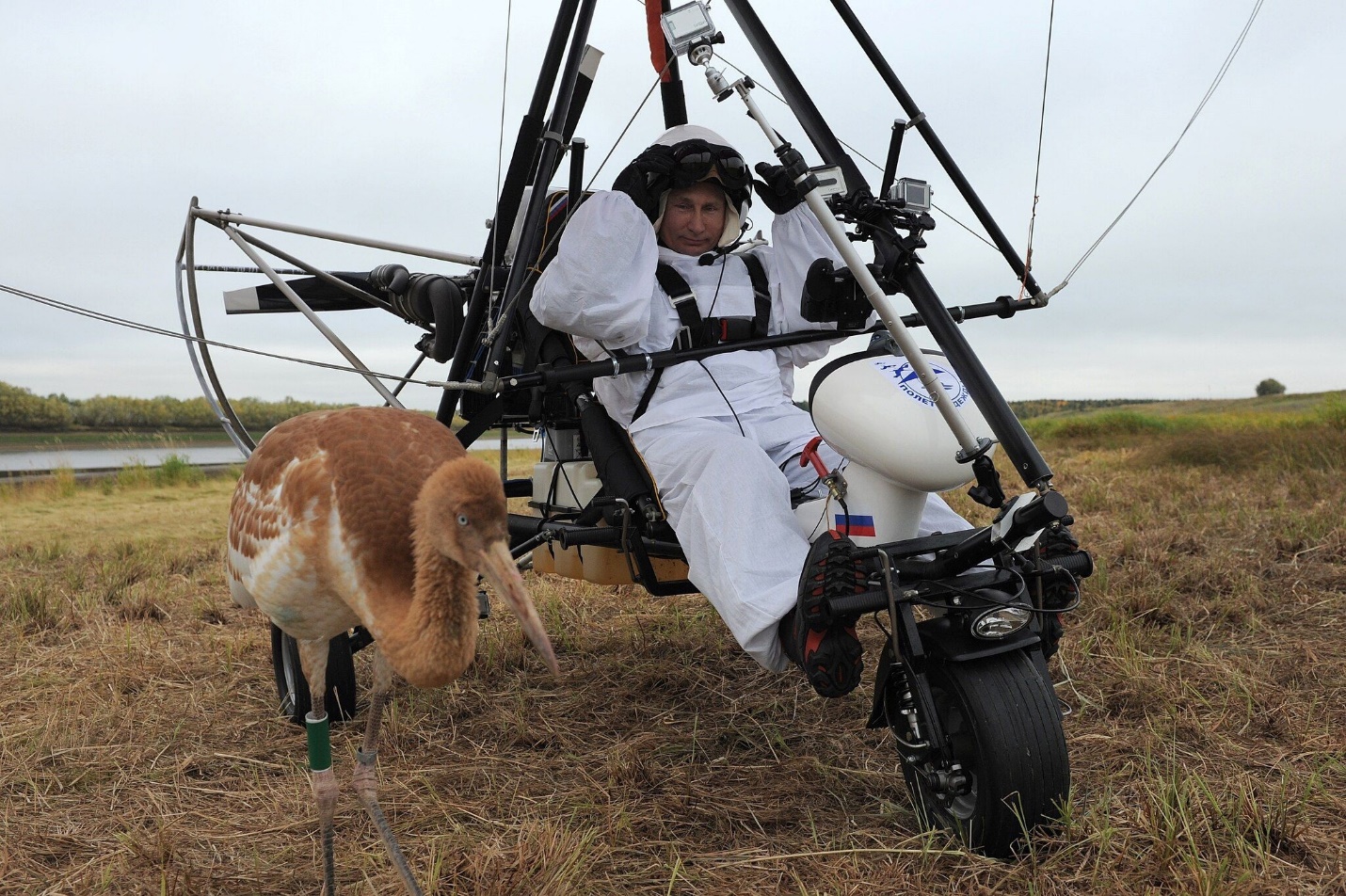
Figure 1: Putin is teaching the cranes to fly in the right direction. Yamal, Russia, September 2012. Kremlin.ru, CC BY 4.0 <https://creativecommons.org/licenses/by/4.0>;, via Wikimedia Commons
This performance of power was partially ironic, with the excessive glorification of the president teetering on the edge of “subversive affirmation” (as per Arns and Sasse). However, this irony only set off rather than obscured the new model of political reality, in which the president, formally an elected administrator for a limited term, was given a religious and mystical function that placed him beyond all constraints, not only legal but also biological. The fact that this performance took place in September 2012, after the protests surrounding Putin’s return for a third term, gave a distinct political meaning to this flight.
The case of Yevgeny Prigozhin deserves special consideration. A professional bandit, he had served over ten years for repeated robberies and was released from prison in the late 1980s. Starting with a hot-dog stand, in five years he became the owner of a restaurant chain and then “Putin’s cook” who not only received the president, foreign guests, and Kremlin bigwigs in his restaurants but also got multimillion contracts to supply schools and the army with food (which was often past its expiration date or otherwise spoiled). Proximity to the sovereign opened the way for Prigozhin’s political career. First, he acquired a media holding company that includes the troll factory that some blame for the outcome of the 2016 U.S. presidential election. Then he became the commander and owner of the state-funded “private” military company Wagner, which carried out operations in Libya, Chad, Cameroon, Sudan, CAR, and Syria. During the full-scale invasion of Ukraine, Wagner, already tens of thousands strong and equipped with all types of weapons except nuclear, began actively recruiting criminals to spearhead the Russian offensive. Having come into conflict with the Ministry of Defense, Prigozhin mutinied in June 2023 and led his troops toward Moscow, meeting no resistance on the way. On the border of the Tula region, he stopped to negotiate, after which he withdrew the mutineers to Belarus – and returned with impunity to Russia, collecting huge sums of money in Moscow and St. Petersburg. However, in August 2023, Prigozhin’s private business jet, with him and all the Wagner commanders inside, began to disintegrate while still in the air and crashed over the Tver’ region.
Prigozhin was a typical political trickster. As a historian Ilya Veniavkin puts it, “at the beginning of its history, PMC ‘Vagner’ acted as an association of trickster’s adventurers – it is no coincidence that their flag featured a pirate skull” (Veniavkin 2023). After Prigozhin’s death, a search of his residence yielded “a cabinet with wigs and a black jacket hung with medals … These items organically complement the collection of fake passports found in Prigozhin’s office on the day of the mutiny and show the carnivalesque essence of his success. Along with the footage from his mansion, photos of Prigozhin sporting different false beards and military uniforms were leaked online. [fig. 2] According to the captions, in them, the businessman plays the roles of field commander Mohammed, a colonel from Tripoli, an employee of the Ministry of Defense of Sudan, and other security forces of different countries. …” (Veniavkin 2023). Ilya Veniavkin rightly sees Prigozhin as aping Putin’s rise to power in an exaggerated, almost grotesque fashion. Just like Putin’s, his tricksterdom had messianic features – he, too, carried the light of the “Russian world” across the globe.
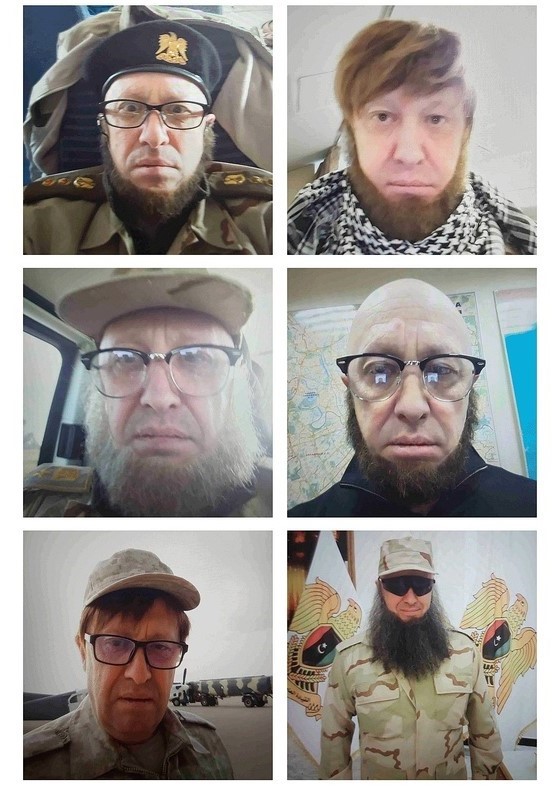
Figure 2: Selfies of Evgeny Prigozhin in different guises found in his office during the police search after his mutiny. https://m.vk.com/wall-29534144_21573027?lang=en
However, as Prigozhin’s story shows, transgressivity has its limits, and these limits are associated with political power. The crimes of the Wagner soldiers, which they themselves proudly report on the internet channels; Prigozhin’s own escapades, incessant lies, and public attacks on the Defense Ministry – all these go unpunished as permissible transgressions. But a march on Moscow in search of “justice,” a march clearly colored in messianic tones, cannot be forgiven, and punishment inevitably follows.
Then again, this cautionary tale can also be read as signaling the end of the trickster era. Gametime is over, there is no more ambivalence, there are no more gray zones, but only an “us” and a “them,” complete with the usual slogans: “Whoever is not with us is against us”; “If the enemy does not surrender, he is exterminated.”
To conclude, the transformation of the trickster narratives into one of hegemonic discourses is not only a testimony to the trickster’s universal success, but also a path to its ultimate crisis. When a narrative is dissipated into a discourse, it loses its form, and with it, its aesthetic power. This means that the trickster cannot serve anymore as the aesthetic justification of cynicism. Rather, cynicism does not need aesthetic justifications anymore, it is fully justified by its hegemonic position.
Written by Mark Lipovetsky, Professor and Chair at the Department of Slavic Languages, Columbia University. He gave a keynote speech at the UCL 200/ UCL Fringe Centre conference, ‘Global Informality in the Arts’, held at Pushkin House on 5-15 January 2026.
Read more: The Soviet Trickster: Cynicism and Its Subversions. Forthcoming by Mark Lipovetsky.
Note: The views expressed in this post are those of the author, and not of the UCL European Institute, nor of UCL.