


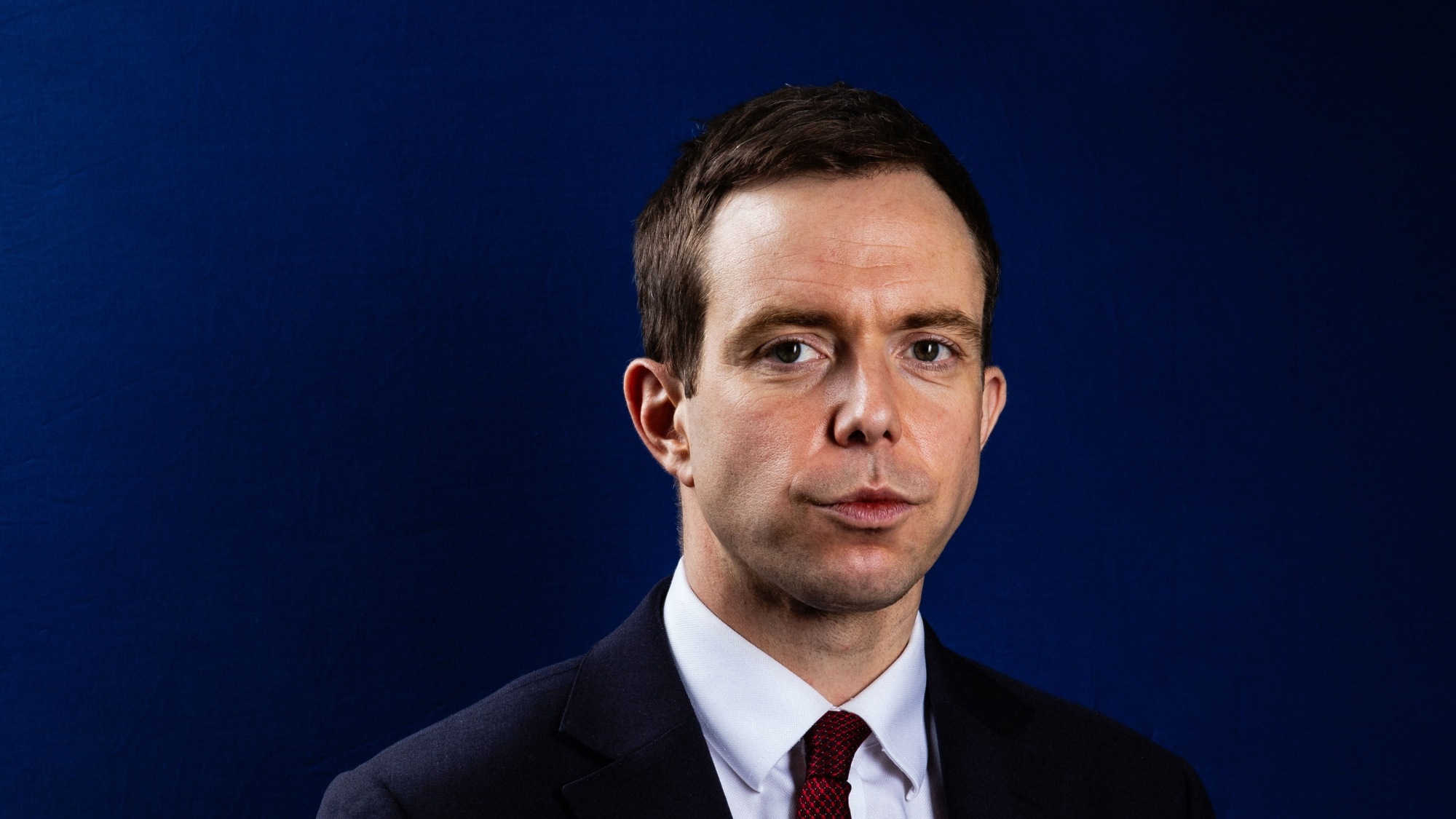
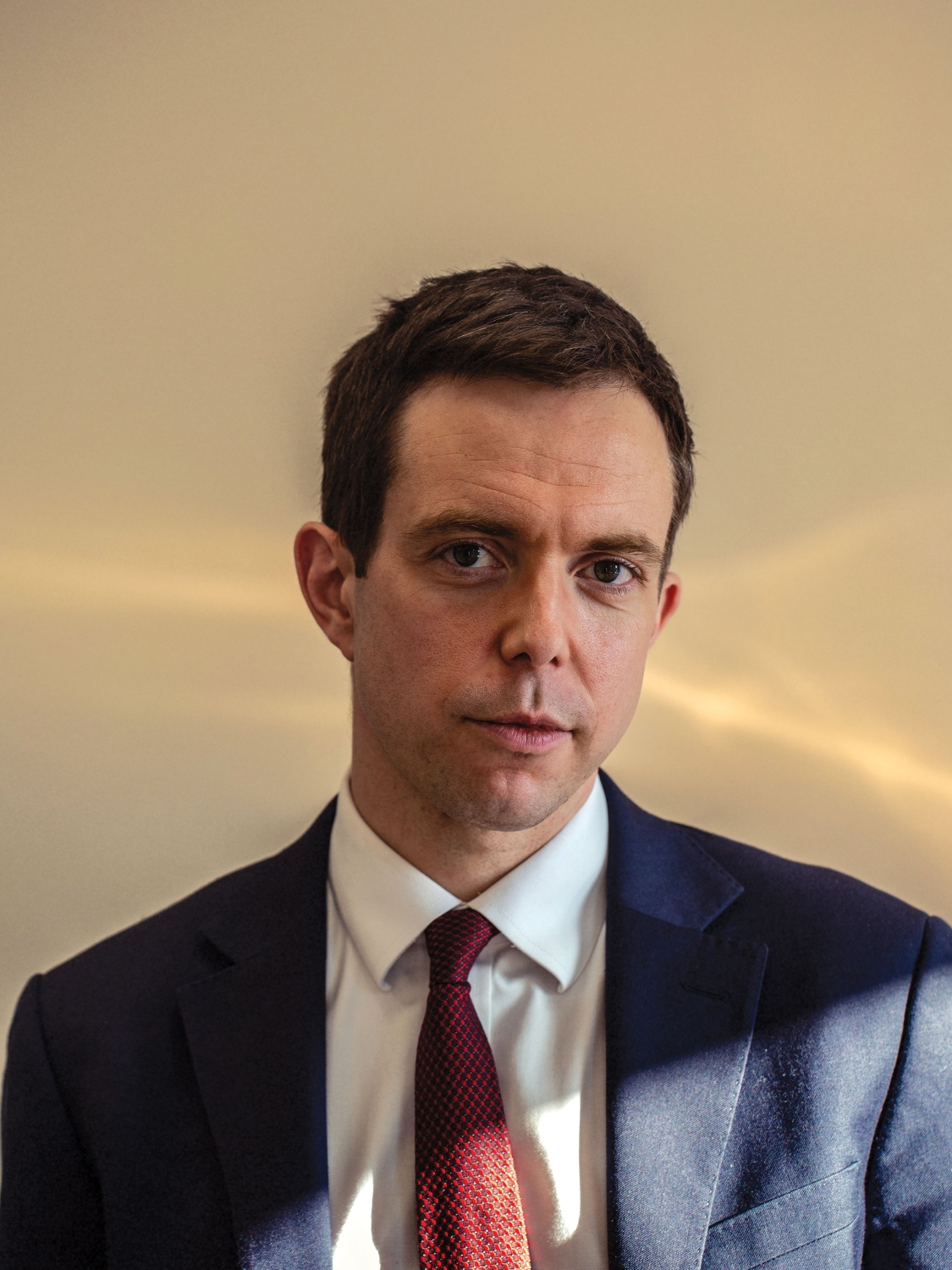
Labour MP and justice minister Jake Richards (Photography by Louise Haywood-Schiefer)

12 min read
Fast-tracked into government after just over a year in Parliament, justice minister Jake Richards tells Sienna Rodgers about his plans to overhaul youth justice, reform the ECHR and face down Labour rebels
The decision to prioritise new intake MPs for promotion at the September reshuffle fuelled resentment in parts of the Parliamentary Labour Party, which lingers still. Among the beneficiaries was Jake Richards, the Labour MP for Rother Valley first elected in 2024, who vaulted from the backbenches into a ministerial post.
Sitting in his Ministry of Justice office, Richards speaks with a zeal that suggests he is determined to prove himself to disgruntled colleagues. He reveals to The House his plans to deliver “the biggest transformation in youth justice for a generation”.
Youth justice, he argues, has defied Britain’s post-2008 decline – but lower numbers in custody mean those settings are now dominated by exceptionally complex cases, marked by profound trauma and serious offences.
“My aim is to dramatically reduce the population in prison,” he declares, citing figures: 40 per cent of children in custody are on remand, not convicted, and 60 per cent of that group never receive a custodial sentence.
“So, a pretty big chunk of the overall population, everyone broadly would agree, shouldn’t be in prison – but they are today. You get that on your desk as a minister in September, and you’re like, ‘Why? What the hell is going on here?’”
A taskforce has been set up to help with “capacity issues” and funding pressures, with a focus on incentivising community placements wherever possible.
The government has ended the use of young offender institutes for girls, and Richards says it is “looking to” end the use of secure training centres for girls too (both were recommended by the 2025 Susannah Hancock independent review of girls in custody).
Girls make up less than two per cent of the children and young people secure estate, which should make reform straightforward. Yet Richards says it is a tall order because “the best settings” – i.e. secure children’s homes – have no duty to accept the toughest cases.
On his first day in this job, he asked for anonymised profiles of the 19 girls in custody. “They are the most traumatic backgrounds of probably many of the children in custody, and the levels of self-harm among those children is pretty shocking,” Richards says.
During a recent visit to Oakhill secure training centre, a facility for boys and girls aged 12 to 18, he asked staff whether they felt equipped to care for the girls in their charge.
“They basically just laughed,” he recounts. “Not because they didn’t care, but because they were just like, ‘We have no idea. These girls are self-harming. They’re not eating. They are aggressive to us.’”
Like many Labour MPs in his intake, Richards endorses an impatient ‘just do it’ model of government. “Why can’t we just get the best child psychologist in the country to write a two-pager and give it to the staff at Oakhill?” he asked.
He recalls telling the Department of Health: “Get me the best person. We don’t need any procurement process. We don’t need a review. Give me the best person just to write them a one-pager – just as a starting point.” But his frustration is evident: “That took, like, six weeks.”
“There are 480 children in custody at the moment. In my head, I can go through some of the names of the children I’ve met, who I think about, and see where the outcomes are. But it is harder than I thought to bring about that change quickly.” He adds, with a laugh: “Which is a running theme with this government!”
Richards also wants to drive up educational standards in youth custody. All providers at England’s single secure training centre and three youth offender institutions for under-18s are rated ‘inadequate’ or ‘requires improvement’ by Ofsted.
“It’s not good enough, and no one was doing anything about it. So, I’m working with Rachel de Souza, children’s commissioner, about a completely new model of education, working with multi-academy trusts to really raise standards. I’ll be looking at those contracts and assessing whether they are viable; whether we need to get out of them as soon as possible.”
Alongside a new mentoring programme – “akin to Teach First, Frontline, Unlocked Grads” – that will see people work with children in custody, he hopes to work on the prevention side. A multi-year funding settlement for youth offender teams, YOTs – to be rebranded as ‘youth justice services’ – is imminent, plus more funding for the MoJ’s knife crime-focused project, Turnaround.
All of this goes to the former barrister’s stated reason for entering Parliament: his experience practising child protection law. The cases were often horrifying – some involved child sexual abuse – and they were evidence, to him, of Tory austerity producing state failure. “It was a real motivating factor to try and leave what was, to be very blunt, quite a nice life as a barrister.”
The cases he took at times challenged his traditional centre-left views. He recalls a foreign national offender who had never worked in the UK, had 11 children, and was accused of raping one of them, who then had a child of their own as a result of the incestuous rape.
“He was living in a flat paid for by the state, by the way. So, it tests your politics from lots of different angles as well. ‘Why is this man here? What are we doing to get rid of him? What are we doing to protect his children and women from this man?’”
Richards represents Rother Valley, the red wall seat adjoining Rotherham, where rape gangs of predominantly Pakistani men were most infamously exposed. While some have complained about the Labour government’s handling and scope of the independent inquiry into the ‘grooming gangs’ scandal, he rejects these criticisms and praises safeguarding minister Jess Phillips.
“Let’s not just listen to Elon Musk on Twitter,” Richards urges. After it was found that insufficient progress had been made on the Alexis Jay recommendations, a national inquiry was launched, he says, “And it’s very difficult to get it right. You’re not going to please all victims with who you have as the chair – that’s just impossible because, unfortunately, there are so many victims.”
He does not accept the allegation, which he raises, that Labour wants to protect its Muslim vote. “Large parts of that community didn’t vote for us [in 2024] anyway, so it wouldn’t be a very smart thing to do in any event. But that’s never been part of any conversation I’ve ever had,” he says. “We have to remember that at the heart of this is some of the most heinous crimes we can imagine.”
It is “absolutely right”, he adds, “that we call out the fact that there were lots of young, white, mainly working-class girls from Rotherham getting raped by predominantly Pakistani groups… I would never shy away from talking about it in those terms.”
“There is a direct link in parts of our country between certain minority groups who have been committing these awful offences, and to deny that I think you’re living in la-la land, not serious, and ultimately letting down victims,” he adds.
He’ll send some emails calling me a ‘genocide enabler’, full stop, and then will say, ‘Lots of love, though. You’re doing a great job’
As foreign national offenders rise up the political agenda, and into Richards’ brief in the shape of ECHR reform, does he believe all those who commit serious offences should be deported?
“Broadly, yes,” he replies. “The starting point is, if you come to this country, you commit a serious offence, then you’re not our problem.”
But he adds an “important caveat”: if the person convicted would be deported to a country where they would not be punished or would be a national security threat, the situation is “slightly different”.
“It may be that the victim’s family says, ‘Well, hold on, you’ve really hurt my son or daughter, you’re going to go back to X country and suddenly be drinking cocktails on the beach? We’d prefer you to stay in custody here.’”
And how confident is he that Labour will succeed in reforming the ECHR, considering the Tories did not?
“I’m very, very confident that we will get where we want to by May this year, which is a political declaration about Article 3 and Article 8. I think that’ll be a big moment. Then what happens after that? We’ll obviously have to see what the nature is of the declaration.”
Oxford-educated Richards, 36, has little in common with the young offenders he is now hoping to help. “I’m very lucky: I came from a privileged background. I had a lot of support and love as a child growing up,” he says.
He joined Labour at a young age. Politics, after all, runs in the family – Richards is what Westminster sometimes calls a ‘red prince’.
His father Steve is a well-known author and journalist, ex-political editor of the New Statesman; his sister Amy is a spad, now No 10’s political director; his brother-in-law, her husband, is Labour MP Gregor Poynton; and just after Christmas he married Liz Bates, formerly of Sky News and now a spad to Steve Reed. They have a young daughter.
He and Amy were steeped in politics from a young age: “It was what we discussed at dinner; we used to watch all the interview shows on a Sunday morning; listened to the Today programme on the way to school.” He did not engage in student politics, though, which he describes as “the epitome of hot air”.
Steve Richards is a frequent critic of Keir Starmer’s approach, his son agrees. “My sister now works directly with Keir, and he’s constantly criticising Keir’s No 10 operation, which includes his daughter,” the minister notes.
His grandfather, “who’s to the left of Jeremy Corbyn”, doesn’t hold back either. “He’ll send some emails calling me a ‘genocide enabler’, full stop, and then will say, ‘Lots of love, though. You’re doing a great job. Very proud of you.’”
There’s a political danger of being seen as a welfarist party… And if we go down that route, we’ll lose the next election
Are the family connections ever awkward? “It’s actually not,” he replies. “We talk about the soft part of politics, the gossip and whatever. But it’s not like we have big debates about what should be in the Budget.”
Perhaps that gossip extends to the leadership questions that dominate Westminster. Asked whether Keir Starmer will still be Prime Minister in a year’s time, Richards replies: “I’m pretty certain that he will be, yeah.”
But not totally certain? “No, I’m certain he will be…. Chopping and changing, assuming there are easy answers to the country’s problems, is not the right approach.”
“I also think it’s very dangerous to underestimate Keir Starmer,” he adds, citing the PM’s record of becoming an MP in 2015, leader in 2020 and surviving the Hartlepool by-election thrashing to win a massive majority in 2024. “I think this guy deserves a bit more admiration and respect than perhaps he’s been given by some quarters.”
Yet the mood of the PLP appears no less rebellious. One tricky issue on the horizon is jury trials: the government is planning to scrap them in England and Wales for crimes carrying a likely sentence of under three years.
Richards – who is double-jobbing as a junior whip – defends the controversial policy, calling the reforms “pretty modest”. He argued against such a move when the Conservatives were in power, though. “I was a lofty barrister writing articles in between cases in my chambers. When you’re in government, you’ve actually got to make decisions that have hard edges to them,” he explains.
Would he be happy with the compromise position, reportedly being considered by officials, of adding two lay people to sit alongside judges in so-called ‘swift courts’?
“I think the legislation will be as Sarah set out,” he says, referring to fellow justice minister Sarah Sackman.
So, that way of watering down the proposal will not happen? “I don’t think so.”
Another potential sticking point is welfare reform, after the government had to abandon its plans last year amid a major MP rebellion. As a red wall MP who is Blue Labour-curious – he is not strictly a member of the socially conservative group but is in the WhatsApp group and says “their focus on working-class communities is a healthy one for the Labour Party” – Richards said before the U-turn on the two-child benefit cap that the money would be better spent on Sure Start.
While he now describes the effect of the government’s new position in favour of scrapping the limit as “fantastic” for child poverty, he warns colleagues: “There’s a political danger of being seen as a welfarist party.”
“The answer to many of the progressive challenges we face – which is that too many children are growing up in poverty, too many families are struggling because of the cost-of-living crisis – is not more welfare alone,” he says.
“It cannot be. And if we go down that route, we won’t help those families that need us most, and we’ll also lose the next election.”
And yet Richards’ own seat was won with a majority of fewer than 1,000 votes. If there were a general election tomorrow, would he keep his seat? He hesitates, smiling. “I think it’d be very close.”