


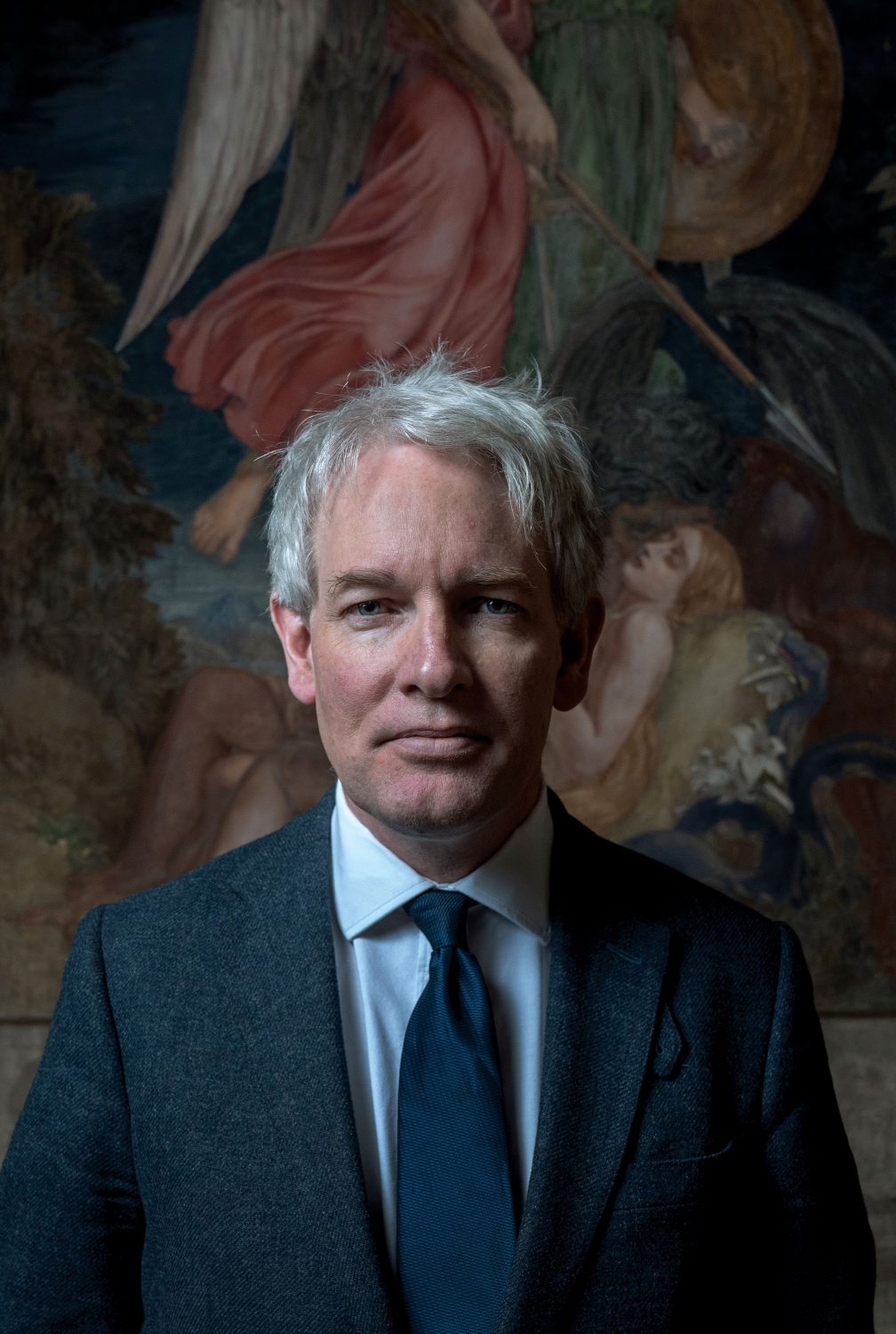
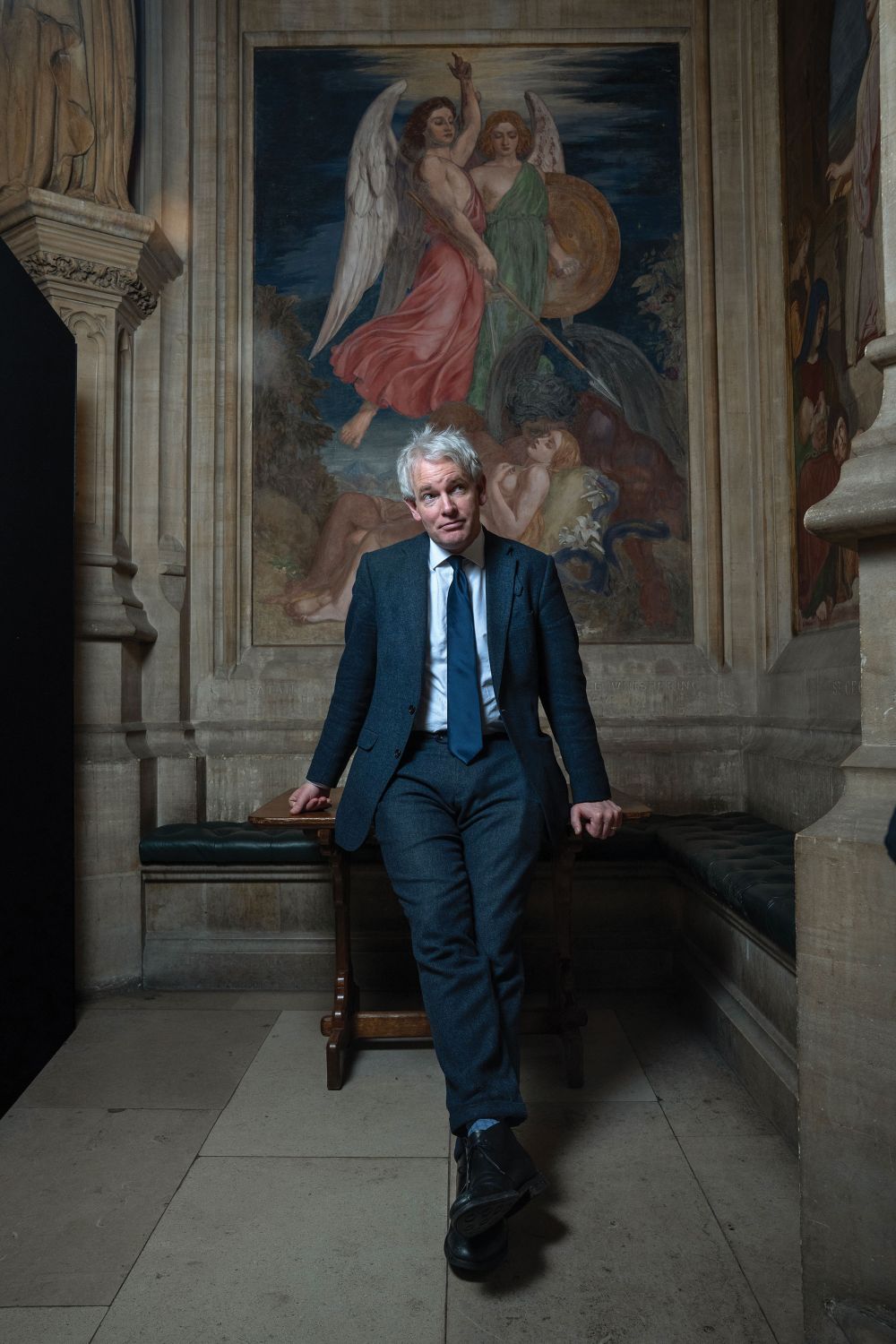
Danny Kruger (Photography by Tom Pilston for The House)

13 min read
Ex-Tory MP Danny Kruger reveals to Sienna Rodgers his plans as Reform UK’s head of preparing for government, from election readiness to pronatalist ambition – and why he fears for Britain if his party makes ‘a mess of it’
A mop of grey hair can be seen bobbing over boxes piled high in a room with walls stripped bare, leaving only hooks missing their pictures. As a pair of podcast hosts stumble out, we shuffle in. Danny Kruger is being kicked out of his parliamentary office.
The Reform MP for East Wiltshire is likely destined for a pokier alternative, somewhere harder to find on the estate. This is his belated punishment, handed down by the whips, for defecting from the Conservatives in September to Nigel Farage’s insurgent party. He was the first sitting MP to make the big leap.
Now tasked with heading up Reform UK’s preparations for government, Kruger says he has “the most exciting job it’s possible to be doing in politics”. So, if there were a general election tomorrow, would his party be ready to govern?
“We’ll be ready when we have to be. There’s not going to be a general election tomorrow,” he replies. “We are getting ready at pace. I would like more time, because I think we will benefit from having our ideas kicked around by more people with expertise.”
With characteristic impishness, he summarises: “The answer to your question is, we’ll be ready when we have to be, but we’ll be readier the later it is.”
His own attention is geared towards the Civil Service, which will see a major headcount reduction under Reform plans. Kruger sets out a private sector-style vision: more people brought in from the outside; ‘high-flyers’ better-paid, with a performance-related element; some recruited for short periods, say six months, to work on a specific task.
Reform will prioritise “people with actual domain expertise” over “these posh generalists who float about from department to department making policy at the moment”, says the Eton-educated MP some would describe as a posh generalist himself.
“A lot of change is coming. Yes, more political appointees, whether they’re spads or civil servants, and a culture which prioritises delivery and genuine subject matter expertise.”
Would his party work with the new cabinet secretary, Antonia Romeo, dubbed “queen of woke” by some conservatives?
“I’m not going to get into individuals, although it’s true to say we are looking at individuals to see who in the current system we expect to work successfully with,” Kruger says. “To get to the top of the Civil Service, it’s quite a bad sign, really. You would have had to really conform to a very, very strict orthodoxy of belief and practice.”
Asked whether a clear-out will therefore be required, he says he is consulting with current and former civil servants to spot talent – or lack thereof – among permanent secretaries (perm secs) and director-generals (DGs).
“Sometimes name me names – ‘Who do you think is good and bad?’ – but mostly, ‘What proportion of the senior civil service, the top 200 perm secs, DGs, do you rate?’” Their answers are “depressing”, he reports.
So, what proportion of the current crop do they categorise as “good”? Kruger spots a journalist’s trap and refuses to give a percentage. “But it’s bad,” he adds.
This all sounds very Dominic Cummings, the former chief of staff to Boris Johnson, and an old friend of Kruger. The prospect of him joining the project is dismissed, however.
“I don’t think there’s any chance of Dominic coming on board. Neither does he want to, nor would Nigel have him. I think he’s put himself out of consideration for direct work in government,” Kruger says.
“I don’t talk to him much because he’s not in the Reform camp, but I read his stuff, and I’ve always thought he was wise and prescient.”
Cummings has warned that Britain is sliding towards civil war, claiming that we are “only random viral posts away from riots and prairie fires getting out of control”. Does Kruger agree?
“Yeah,” he replies. The left portrays Reform as “rabble-rousers” who incite division, which could become violence. “The total opposite is the case. The only chance of unity for our country is Reform,” the MP continues. “If we don’t win, or if we win and then make a mess of it, I do fear for our country.”
Life as a small-c conservative has been a pain of late, including under recent Tory administrations. “We fight the long defeat, as Tolkien said. We’re always losing,” as Kruger puts it.
Yet he fully believes that the winds are changing now. The mood of the country has shifted, and those in power, still embracing “the cult of the independent individual” without “any obligations beyond self-gratification”, are lagging behind.
“We’re all realising how empty that philosophy is and how destructive it is of society,” he says. “The Reform slogan is family, community, country. We’re talking about the associations that give us meaning and identity and security and a sense of belonging. I think that’s where the country is now going – away from a doctrine of total liberal individualism.”
“I’ve been hoping for a return to IDS all these years, but I found that in Nigel – he is my IDS”
Kruger, 51, made his start in politics at the Centre for Policy Studies think tank and then as an adviser in the Conservative Party’s policy unit, initially under Iain Duncan Smith. After a stint as the Telegraph’s chief leader writer, he started writing David Cameron’s speeches – including, most memorably, the “hug-a-hoodie” one. He insists his politics have not budged over the years, however.
“I remain quite proud of that speech,” he says, explaining that it was actually very conservative, advocating proper punishment of criminals as well as love for young people at risk of crime. (His embrace of words like “love” is not unusual for politicians driven by their faith – Kruger became a Christian in his 20s, after meeting his wife, Emma – and should not be mistaken for softness of politics.) He left Cameron in 2008 to work full-time on the youth crime prevention charity he co-founded.
“I’ve always been a social conservative. The bits of Cameronism that I approved of, like the Big Society, I still approve of. I was always a Brexiteer.”
He is “probably less of a neocon”, though: “I supported the Iraq War – I regret that.” He regrets, too, supporting parts of the Covid response before later becoming a strong lockdown critic.
“I was the token right-winger in the Cameron team. I was probably most at home, in all of these Tory leaders I worked for, with IDS, in the 2003 era. So, I’ve been hoping for a return to IDS all these years, but I found that in Nigel – he is my IDS.”
Kruger has been prominent over the last year not only because of his defection but also his opposition to assisted dying.
“My expectation is that they’re going to run out of time,” he says of Kim Leadbeater’s bill currently before Parliament. “While I oppose the bill, and I will oppose any assisted dying bill because I don’t think it’s possible to craft a safe one, you could craft a much safer one than this.” He does not accept that peers have been filibustering to kill the bill.
Kruger’s mother, Bake Off star Prue Leith, has been one of the celebrities at the fore of the pro-assisted dying campaign. They made a documentary together about the subject, through which they came to better understand each other’s views.
“It’s been a bit difficult sometimes, because it matters a lot to both of us, and we haven’t been prepared to stop. She’s committed to the campaign; I’m committed to resisting it. But, no, overwhelmingly, I salute my mum for not minding that I am leading, or one of the leaders of, the campaign to stop her getting her way,” he says. “Neither of us is budging. That’s OK.”
The other big social reform put before MPs recently was the decriminalisation of abortion at any point during pregnancy, via an amendment by Labour MP Tonia Antoniazzi. Unlike the assisted dying legislation, it passed the Commons easily.
“I thought it was a real shame that we did that – as a country, as a Parliament. Again, totally understand the argument for it, but it has sent a very, very strong signal that it is acceptable to abort a viable baby at nine months,” Kruger says. He also argues it has put vulnerable women at further risk of coercion by abusive partners. (Advocates of decriminalisation naturally disagree on both points.)
“The fact it happened the same week as the assisted dying bill just struck me as a very, very dark episode in our national life.”
In Kruger’s 2023 book Covenant, which outlines his conservative communitarian philosophy, he describes sex as being a private act done almost in public, when it should really be a public act done in private. What role does he believe a political party can have in undoing the sexual revolution, or resetting our sexual culture?
“A limited but important one,” he replies. He is clear that every government policy is “critically important to the way families form” and confirms that Reform UK is looking at switching our tax system to be based on households rather than individuals.
“Marriage traditionally was the means by which sexual relations between men and women were regulated, and I think we are suffering from having a totally unregulated sexual economy,” he says.
“I’m not interested in your love life, or anything about your personal life – that is your business. But I am interested in the framework in which you make your decisions, and I’d like the framework to be more pro-social. If you want – most people do want – to settle down with one person to have children, we should make that easier.”
While he is against the 2022 introduction of no-fault divorce, because the landmark change “basically means that your vows don’t matter”, he does not commit to overturning it. “I don’t know whether we’d be able to reverse it,” he says. “I don’t think that would be party policy, to change that.”
It may not include this one, but – with Reform UK figures concerned about our low birth rate – the party is developing a suite of fertility-boosting policies, he confirms: “Yes, we have a pronatalist ambition. We want people to have more children, and we think the government should get behind that wish.”
Expect more from Reform on childcare, for example: “Clearly, the system is totally dysfunctional. There’s a massive disincentive for parents to be able to organise their finances around their actual lives. It’s broken.”
Kruger must be serious about getting into power: he appears to position himself as less right-wing now that he has joined Reform than he did as a Tory.
Asked about his past interest in dismantling the welfare state in favour of the ‘Big Society’, he maintains that the latter was “the best aspect of the Cameron government – except the referendum, of course” and criticises welfare dependence, before pointing out that “we don’t want to dismantle the public services that people rely on”.
Is he remembering his call for “a period of creative destruction in the public services”, which forced him to stand down as a 2005 Tory candidate? “Yes, yes, I don’t want to walk into that one,” he smiles.
“Let’s not pretend otherwise: there is a clear affinity of worldview between the Maga movement and Reform”
As we discuss the British shibboleths that Reform cannot afford to be seen as having any wish to meddle with, Kruger rejects any notion of switching away from the current NHS funding model. Instead, he expands on his view that the real problem is that this country is very sick. He talks of “the principle that there’s often better alternatives than a pharmaceutical prescription or a medical treatment” – so, is he against obesity jabs?
“I’m no expert. I don’t want to wade into a debate where I don’t have the expertise – that doesn’t stop me always, but on this occasion…” Another smile. “Instinctively, I’m suspicious of a solution that seems so easy.” He is “not a caveman” and is “very pro-tech”, yet “shortcuts feel to me to be dangerous. But who am I to object?”
On the subject of Reform’s electoral vulnerabilities, The House probes Nigel Farage’s closeness with President Trump. Is that a challenge for the domestic audience?
“Clearly, Donald Trump is not wildly popular in the UK, and the fact that we have and Nigel has a personal friendship with him, might not be advantageous,” he says.
“On the other hand, I think it reflects well on Nigel that he’s stood by Donald Trump, including when Trump was down, and that relationship is very, very useful, potentially, to the United Kingdom and to a Reform government. And let’s not pretend otherwise: there is a clear affinity of worldview between the Maga movement and Reform.”
Kruger clarifies: “The US is a very different place. We don’t want to mirror their politics. We don’t want to follow everything that the current administration is doing in the UK, far from it. But the US and the Republicans are the best friends this country could have.”
The Reform MP seems genuinely comfortable in his new home. He claims not to know whether more Conservative MPs will follow suit, saying it is “a very personal decision” and “not for me to decide who Nigel would want to have anyway”.
He delivers the pitch anyway: “If you’re an authentic conservative, your patriotic duty is to join Reform – unless you’ve got some massive personal problem with some policy we’ve got, or people. But you shouldn’t.”
So, if Farage’s party forms the official opposition or government, which jobs does he have his eye on? The Department for Work and Pensions, perhaps?
“I would like to start putting in my bids for jobs now, but I won’t. Who knows what Nigel will want from each of us?” Kruger replies, acknowledging that “yeah, social policy is where I feel most expert”.
Could he be in the Cabinet Office – Reform’s Pat McFadden? “The Oliver Letwin of the operation! Again, we don’t know what the structures of government are going to be, what roles will exist, what departments we’ll have. I think there needs to be some machinery of government changes.”
The cabinet, he says, “will look smaller” and Farage has confirmed that the jobs will not all go to MPs, “so there might not be room for me”.
That would seem rather harsh, considering what a significant step he took in defecting. “I might have screwed up by then. My normal trajectory is to do something catastrophic and blow myself up. So, let’s see what I do next.”