

Gender equality has long been a stated priority of the European Commission. From gender mainstreaming commitments to equality strategies, the EU presents itself as a global leader in promoting women’s political representation and equality. But what about gender equality in the Commission itself? Following from previous work (Coen, Katsaitis, Vannoni 2025), we examine the European Commission’s staffing based on data provided through the EU’s Directorate General for Human Resources and Security annual statistical bulletin. We are particularly interested in observing changes in gender distribution across different Directorate Generals (DGs), across different levels of employment, and staff’s nationality. This goes to the heart of democratic credibility, institutional coherence, and the broader politics of representation in the EU.
Staff Categories
We note that EU staff belong to different categories (officials, and civil service). The EU’s civil service has three main staff categories: administrators (AD), assistants (AST), and assistants/ clerks (AST/ SC). In our analysis we focus on administrators (AD) and assistants (AST) that form the vast majority of EU staff, and are more closely linked to policy.
A comparison of the Commission’s HR bulletins from 2018 and 2023 reveals measurable progress. Across the institution, gender balance has improved – most notably within the Administrator (AD) function group, which includes policy officers and senior officials responsible for drafting legislation and engaging with stakeholders. Historically, the AD category exhibited gender imbalances, particularly at higher grades. By 2023, however, the distribution of women and men across AD grades appears more balanced. This shift is important. AD officials sit at the core of EU policymaking. Greater gender parity in this group signals also a potential transformation in who shapes EU public policy. While parity has not yet been fully achieved at all levels, the trajectory is clearly positive. Institutional measures aimed at improving recruitment, promotion transparency, and career development appear to be having an effect.
Figure 1: Showing the share of male to total/ female to total share of staff in the administrator (AD) and assistant (AST) categories over time.
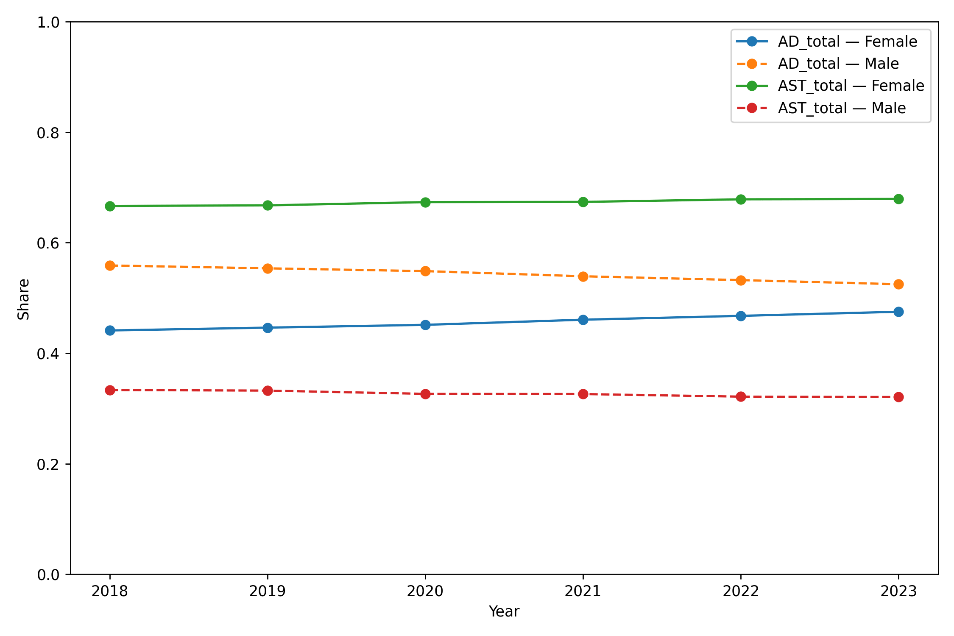
The picture is more stable in the Assistant (AST) function group. AST roles – often administrative or executive in nature – have long been female-majority positions. Between 2018 and 2023, only minor shifts are visible. Stability here is less surprising. Yet it also raises a broader question: gender equality is not only about increasing women’s presence where they are underrepresented; it is also about interrogating why certain roles remain persistently gendered. If administrative roles continue to attract (or channel) women disproportionately, deeper structural dynamics may be at play.
Inequality Across Staff Levels, DGs and Nationality
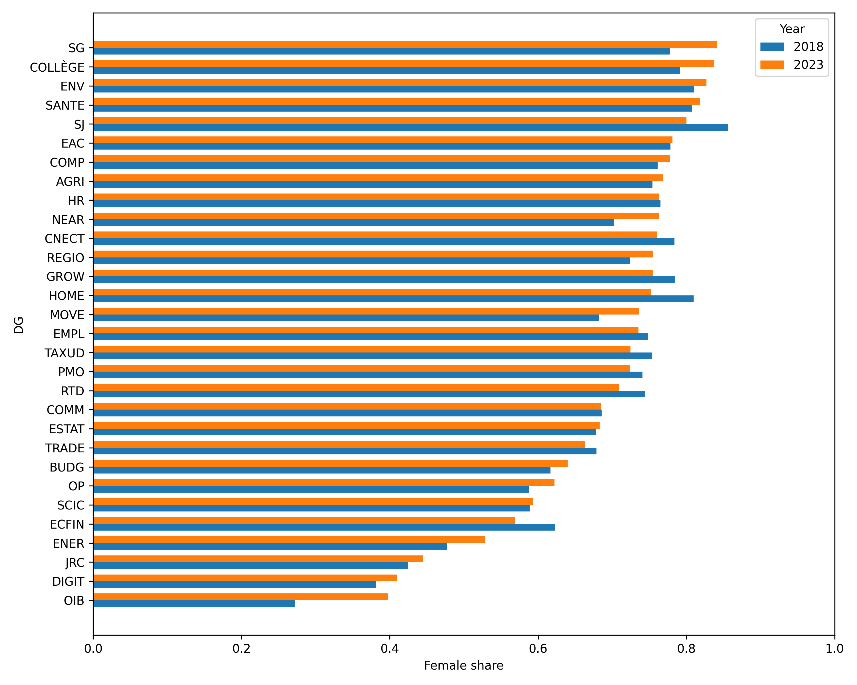
Looking across Directorates-General (DGs), variation becomes more pronounced. While AST staff tend to display relatively balanced gender distributions across DGs, AD staff show greater disparities – particularly in more technical or specialised DGs. This pattern mirrors broader labour market trends. Policy areas linked to economics, industry, or digital policy often reflect longstanding gender imbalances in STEM-related fields. The Commission does not operate in isolation from these dynamics; rather, it appears to reproduce, to some extent, professional “gendering” patterns embedded in national education systems and labour markets.
Figure 2a: Showing the share of female staff in the administrator category (AD) across DGs.
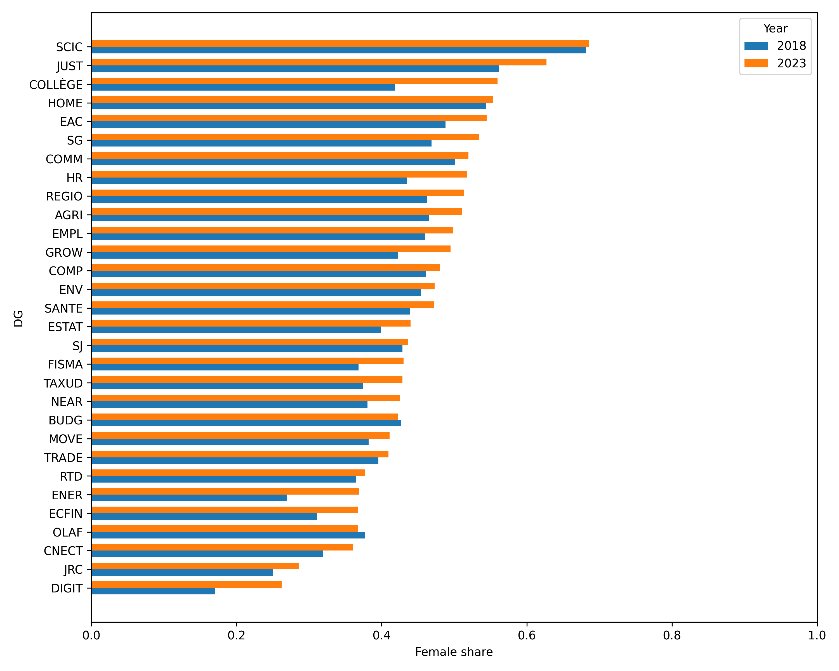
Figure 2a: Showing the share of female staff in the assistant category (AST) across DGs.
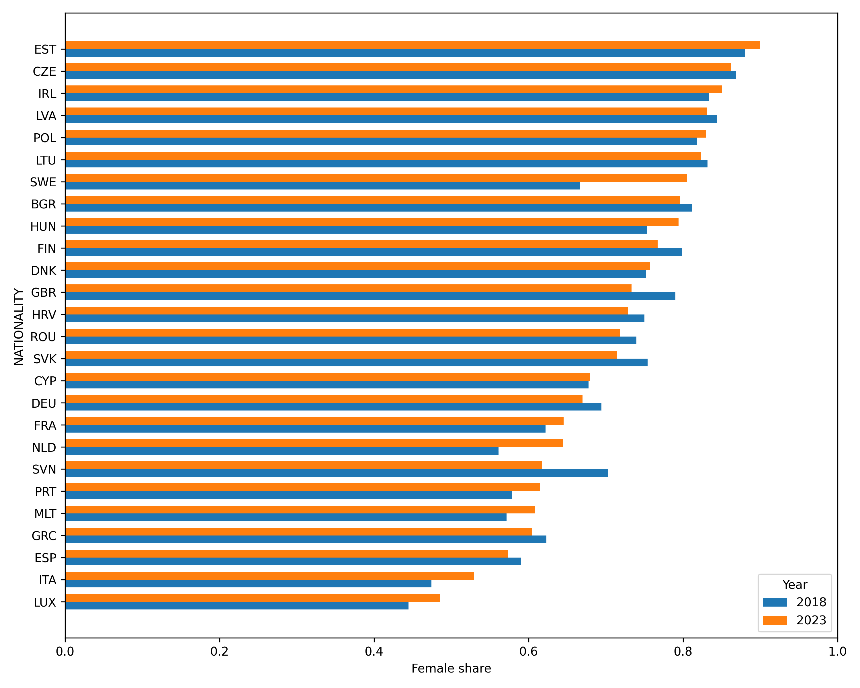
Nationality further complicates the picture. The data suggest that officials from older and larger Member States tend to exhibit weaker gender balance, particularly within the AD category, while several smaller or newer Member States demonstrate comparatively more equal representation. It remains unclear whether these differences stem from recruitment practices, promotion pipelines, national applicant pools, or broader socio-economic factors. As the report notes, disentangling demand-side from supply-side explanations would require further research.
Figure 3a: Showing the share of female staff in the administrator category (AD) across different nationalities.
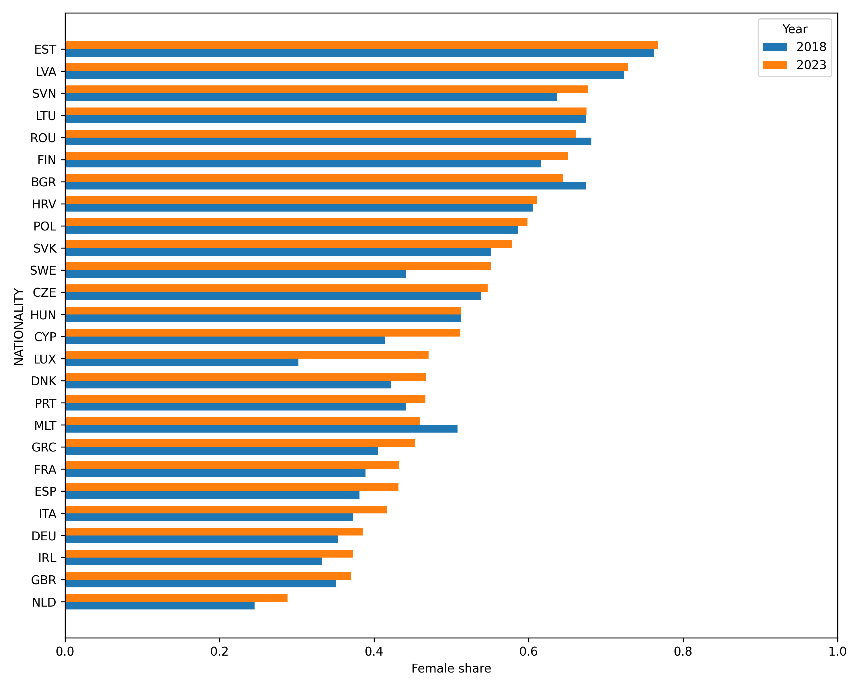
Figure 3a: Showing the share of female staff in the assistant category (AST) across different nationalities.
Why Does this Matter?
Taken together, the HR trends and emerging research point to a cautiously optimistic conclusion. The direction of change between 2018 and 2023 is positive. Improvements in AD gender balance indicate that sustained institutional attention can yield results. Yet disparities across DGs, grades, and nationalities demonstrate that equality is not uniformly embedded across the institution.
Beyond descriptive trends, these developments also carry broader theoretical and policy implications. From a theoretical perspective, the Commission’s evolving gender balance speaks directly to debates on descriptive versus substantive representation. Institutionalist scholarship has long argued that who occupies decision-making positions shapes not only internal dynamics but also policy priorities and outcomes. If AD-level parity continues to improve, this may influence agenda-setting processes, deliberative cultures, and the types of expertise that are recognised and valued within the institution. The evidence linking gender composition to lobbying strategies further suggests that representation has systemic effects: changes inside public institutions can reshape patterns of access, influence, and political opportunity in the wider governance ecosystem.
From a policy standpoint, the findings underscore the importance of sustained and targeted equality strategies. Progress appears linked to deliberate institutional measures, suggesting that recruitment procedures, promotion monitoring, mentoring schemes, and transparency mechanisms matter. However, persistent variation across DGs and nationalities indicates that horizontal, one-size-fits-all approaches may be insufficient. More tailored interventions – particularly in technical/ gendered policy areas and senior leadership tracks – may be necessary to address deeper structural imbalances. Continued monitoring, transparent reporting, and data-driven evaluation will be essential to ensure that progress is consolidated and extended across the entire institution.
The European Commission has clearly moved forward. The challenge now is to ensure that gender equality is not only improved in aggregate terms but embedded across functions, policy areas, and leadership levels-so that representation becomes a durable feature of European governance rather than a fluctuating achievement.by its hegemonic position.
Written by David Coen (University College London), Alexander Katsaitis (Stockholm University), Matia Vannoni (Kings College London)
Note: The views expressed in this post are those of the authors, and not of the UCL European Institute, nor of UCL.
Photo: EUMESTAT.