

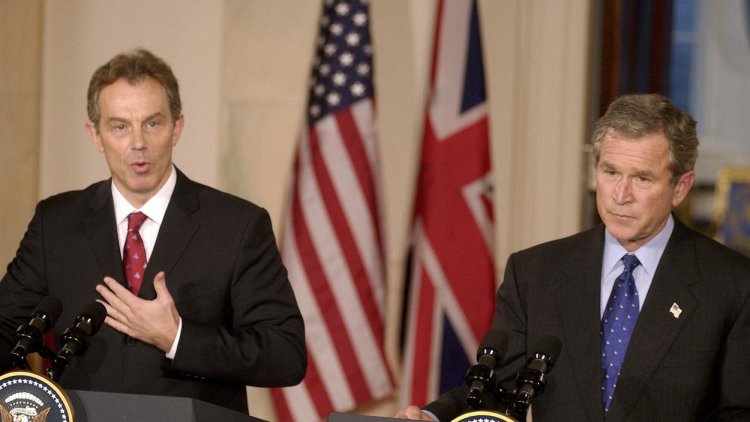
US President George W. Bush and British Prime Minister Tony Blair held a press conference at the White House in early 2003 to discuss Iraq (Alamy)
9 min read
As the Iran conflict continues, the lessons and warnings from the 2003 invasion of Iraq and its long aftermath are shaping the response of Labour ministers and MPs.
As the seventh day of the conflict between the United States, Israel and Iran unfolds, Prime Minister Sir Keir Starmer’s government has faced a complex geopolitical challenge. After initial US-Israeli air strikes on Iranian military infrastructure last Saturday, Iran responded with waves of missile and drone attacks across the region, and the conflict has since expanded rapidly.
The UK initially declined a direct request from Washington to allow US forces to use British military bases to launch attacks on Iran. But following Iranian strikes on regional allies, including British personnel and bases, the government agreed to allow the US to use UK bases for limited defensive operations, aimed at neutralising missile and drone threats.
Labour ministers insist the response has been measured and lawful, focused on protecting UK personnel, interests and civilians in a volatile region. Starmer has refused to echo stronger offensive positions called for abroad, prompting Donald Trump to criticise the Prime Minister’s stance as “very disappointing”.
For many Labour ministers and MPs, the Iraq War of 2003-2011 remains a source of political trauma and a guiding lesson for how the UK engages in the Middle East. Speaking on his Political Currency podcast this week, former Cabinet minister Ed Balls said Starmer’s approach had been influenced by Iraq.
“Ever since Iraq, from the moment Gordon Brown became prime minister, the aftermath of Iraq has hung over the Labour Party,” he said.
“It absolutely shapes the politics, which is: Don’t just go in without a legal basis and without a clear plan, because that could end up an absolute political catastrophe.”
The Iraq War: a political and military turning point
The 2003 invasion of Iraq was a seismic event in British political history. Led internationally by the United States with support from Labour prime minister Tony Blair, British forces joined the attack on Saddam Hussein’s regime on the basis of an asserted threat from weapons of mass destruction – weapons that were never found.
The war toppled Hussein but unleashed years of insurgency, sectarian violence and regional destabilisation. Later inquiries, including the Chilcot report, condemned the UK’s decision-making and lack of post-conflict planning.
For the Labour Party, Iraq fractured party unity, damaged public trust, and represented flawed intelligence, weak strategy and “forever wars”. Figures who opposed the war from the start later felt their warnings vindicated.
The risk of ‘mission creep’
One such figure is Richard Burgon, Labour MP for Leeds East, who attended his first demonstration as a student against the Iraq War.
From the Labour backbenches, Burgon has taken a leading role on the left in criticising UK involvement in the Iran conflict.
“The campaign against the Iraq War made a big, big impression on me,” Burgon told PoliticsHome.
“The shadow of Iraq quite rightly hangs over foreign policy considerations and considerations of military involvement. We’ve seen in Iraq, in Afghanistan, in Libya, what this can lead to. It can lead to death, destruction and chaos impacting tens of millions of people, and obviously the view of the of the public on the politicians who have been part of that will be formed accordingly.”
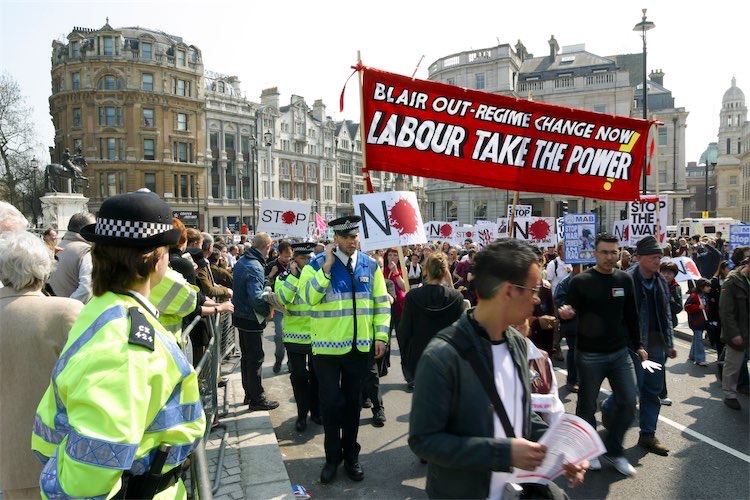
On 18 March 2003, Parliament passed a motion to “use all means necessary to ensure the disarmament of Iraq’s weapons of mass destruction”. Of Labour MPs at the time, 254 voted in favour, 84 against and 69 abstained, meaning around 60 per cent supported the invasion.
“Parliament overall, despite the big vote against the Iraq War, gave Tony Blair the benefit of the doubt, and many, many MPs who did so regretted that, not only for the rest of their political career, but for the rest of their lives now,” Burgon said.
He argued that the legacy of Iraq makes MPs very wary of the risk of “mission creep”, and less willing to accept assurances from prime ministers or allies that the UK will not be drawn into a longer, wider conflict.
Setting boundaries on military intervention
While Burgon opposes any British military action in Iran, others argue the line should be drawn at defensive air operations while refusing to commit land troops.
Lord Peter Ricketts, former Permanent Secretary at the Foreign Office between 2006 and 2010, said Iraq established a clear British approach: “no boots on the ground”.
“In Libya in 2011, particularly, which I was very involved with, the principle at the outset was that we could do an air campaign, but no boots on the ground,” he said.
Legal lessons from Chilcot
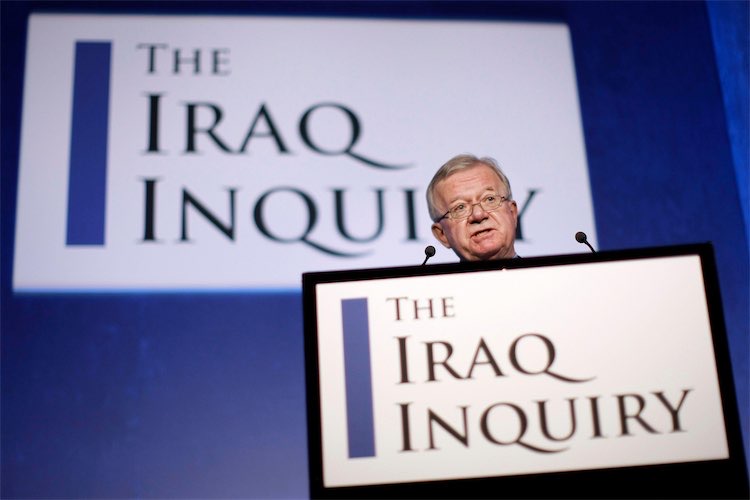
Ricketts also highlighted international legitimacy as a key lesson. The Chilcot report concluded the Iraq invasion was “not a last resort” and criticised the legal and diplomatic groundwork.
“I completely agree with Starmer’s stance that the assault [on Iran] at the beginning was not lawful,” Ricketts said.
“The British government and Tony Blair learned the hard way that having any doubt about the legal basis caused massive problems for him in UK Parliament and UK public opinion, and has dogged him ever since.”
Questions of legality were central to the UK’s initial refusal of Trump’s request to use Diego Garcia and RAF Fairford. It was largely on this basis that cabinet ministers, including Ed Miliband, Rachel Reeves, Yvette Cooper and Shabana Mahmood, were opposed to Starmer approving the request, according to the Spectator.
The Chilcot Report’s lessons are also directly informing discussions between backbenchers on the Iran conflict. Calvin Bailey, former RAF officer and MP for Leyton and Wanstead, spoke at the PLP meeting earlier this week and advised colleagues to read The Good Operation, a handbook inspired by Chilcot to help MPs ask the right questions when planning military interventions.
Post-conflict objectives
Another reason for British caution is uncertainty over US and Israeli objectives in the region. Trump and administration officials have sent mixed messages on whether their goal is regime change in Tehran, including urging Iranians to “take back your government” while asserting a focus on destroying nuclear capabilities.
Clive Betts, who has served as a Labour MP in Sheffield since 1992, said the government is balancing competing priorities.
“Essentially, the Prime Minister was in a difficult position and played it as well as he could,” he told PoliticsHome.
“The lesson from Iraq is don’t start something unless you know how to finish it. But then I’d say we have to protect British bases, like in Cyprus, and protect UK nationals. We aren’t doing what we did in Iraq and joining in the American attack. I don’t think the answer can be nothing when we have British soldiers. We have a responsibility for UK nationals and troops.”
The situation has also renewed scrutiny of the UK-US “special relationship” and raised questions about whether alignment with Washington is politically or strategically beneficial for Labour. Some Labour Cabinet ministers, particularly Miliband, do not want the UK to be led once again into a foreign conflict by the US.
The risk for Labour’s political legacy
The legacy of the Iraq War also weighs heavily on the British public, which has remained deeply sceptical about overseas military intervention. Public trust in government assertions about threats and strategy plummeted after Iraq and has never fully recovered.
“The Iraq War started off being relatively popular because the public believed Blair’s warning that the weapons of mass destruction could pose a real risk,” Ricketts said.
“But it very quickly drained away, in particular when the casualties started. Public opinion is already very wary of this exercise, and it must be getting warier every day… all the negatives will come through. And so it’s only going to get less and less popular here.”
Many Labour MPs elected over the last 10-20 years grew up politically during Iraq’s peak, witnessing first-hand how it damaged trust in the party and government. Paul Foster, MP for South Ribble and a former army officer, said he left the military in 2003 “knowing the decision that was being made was the wrong decision for the wrong reasons”.
“For Tony Blair, even now, Iraq is all he is remembered for,” Foster said. “We did not achieve anything in the Middle East that we were meant to achieve.”
Senior Cabinet ministers are aware of this risk for the current Labour administration. PoliticsHome understands that Defence Secretary John Healey has been engaging with individual backbench Labour MPs in an attempt to reassure them that the UK military involvement in Iran will remain limited.
A flawed comparison
Many senior diplomats and former MPs argue the parallels with Iraq are limited. William Patey, UK ambassador to Iraq during 2002-05, emphasised that ground troops are not being asked for in Iran, unlike the central feature of Iraq.
“The ask is much less, and it’s a different proposition altogether,” he said. “While Iraq has shaped political and public attitudes, it should not dictate the legal and practical decisions taken in the current circumstances.”
UK defence capabilities have also shrunk since 2003, making a large-scale military commitment impossible. Some MPs worry that further action in Iran could compromise the UK’s support elsewhere.
One right-wing Labour MP said: “I’m worried if we committed ammunition and kit to bombing Iran that would compromise our help for Ukraine.”
Looking ahead
Left-wing MPs like Burgon believe a mass opposition movement will be necessary if UK involvement escalates, similar to the protests against Iraq.
“We’ve seen that in relation to a mass movement against Israel’s war on Gaza, and people can see more clearly now than they used to be able to on their mobile phones, on their TVs, the consequences of war, the innocent men, women and children who are killed,” he said.
He predicts opposition in the parliamentary Labour Party will grow if the conflict drags on. “Lots of those people will end up being sadly disappointed as this develops.”
For others who support the UK’s defensive operations in Iran, the hope is that the very limited nature of the military engagement will prevent the UK from becoming entangled in another complex war in the Middle East that drags on for years.
As intense exchanges of air strikes and missile attacks continue in the Middle East and greater economic and humanitarian impacts begin to be felt at both home and abroad, Labour politicians will continue to draw lessons and warnings from the Iraq War more than 20 years later.