

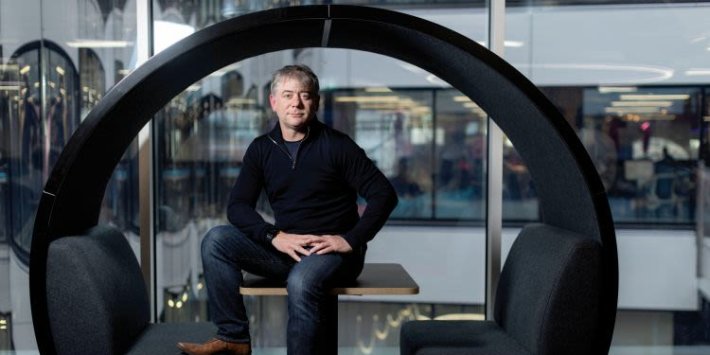
Greg Jackson (Alamy)
7 min read
Charming and well-connected, Octopus founder Greg Jackson is one of the most influential businesspeople in this Labour government’s orbit. Ben Gartside explores his politics and reach
“A very senior mandarin in the energy space said to me that the traditional model of the energy companies was to keep quiet and hope nobody understood what they were doing, and not to wake the sleeping dog,” Greg Jackson recalls, over a video call in a black hoodie, having just returned to the UK. “And I said, ‘Well, my job is to come in and poke the sleeping dog with a stick relentlessly’.”
Jackson has just returned from China, where he was part of the Prime Minister’s delegation. The Octopus founder is in as boisterous a mood as ever.
“Companies are often extremely entitled, or they behave in an entitled way. I’ve seen energy bosses demanding that the Energy Secretary actually make them more trusted,” a disapproving Jackson reports. “Trust is earned, not bestowed,” he adds.
Despite Jackson’s Octopus being only 10 years old, it has achieved continued astronomic growth after breaking ‘double unicorn’ status in 2022, reaching a valuation of $2bn, and has become one of the most recognisable in the UK, levering its outsider status for success.
In Whitehall, Jackson has seen similar achievements. The founder is a regular at political events, sitting on boards across Westminster while also recently securing a £25m investment from the government in his Octopus Energy spin-off, Kraken. Energy Secretary Ed Miliband has described him as a “friend”, and insiders see him as the corporate figure who has the closest ties to the government.
In spite of this, Jackson recoils at the idea of being politically influential.
“I’ve got literally no view of politics,” he says unconvincingly, before launching into a 10-minute explanation of UK-China policy and the benefits of free trade. Jackson’s ideology, if he has one, is neoliberal. He believes in low subsidies, high competition and transparency, making him an odd bedfellow of the Labour Party.
“I don’t believe in party politics, but I do believe in the power of competition and the power of free enterprise.”
A close adviser of a previous Conservative chancellor described Jackson as “very good at identifying power, getting close to it and using those relationships to build credibility. He’s always coming to the government with solutions rather than just problems. A lot of companies can learn from that”.
After the change of government in 2024, Jackson was appointed to the government’s Industrial Strategy Advisory Council, before becoming a Cabinet Office board member in July last year. In January, he was appointed as co-chair of the Department for Science, Innovation and Technology’s attempts to use AI to improve customer service experiences.
He has been vocally supportive of a number of government policies: in the last year alone, he endorsed the Workers’ Rights Bill, supported plans to build a ‘clean-power army’, and co-signed the government’s “international investment summit”.
I’ve seen energy bosses demanding that the Energy Secretary actually make them more trusted
Rumours have swirled that Jackson was on Labour’s longlist for a potential investment minister, before it was offered to his former colleague Benjamin Wegg-Prosser and ultimately Baroness Gustafsson, who accepted (before later resigning). Jackson says he doesn’t know whether he was considered but would not have accepted the job anyway.
He has also faced sustained criticism from some in the labour movement. Energy tycoon and Labour mega donor Dale Vince has engaged in a war of words with Jackson over green energy, both accusing the other of doing climate deniers’ bidding.
Miliband has remained a supportive ally of Jackson, however, launching numerous major policies from his sites, meeting regularly with him in Whitehall and name-checking Octopus’ successes. Their friendship has caused controversy for them both.
In some ways, the two are unlikely allies. Despite his links to the Labour Party, Jackson is not and has never been a party donor, and labels himself a free marketeer. He prompted criticism in 2021 when he admitted that his companies do not have human resources departments.
One of Jackson’s biggest squabbles is with the GMB union, which represents Jackson’s workforce in Octopus.
A GMB spokesperson describes Octopus as having a “frat-boy culture”, describing it as “beyond baffling” that Miliband and other ministers “persist in indulging this divisive figure”.
“GMB members in Octopus are increasingly outraged by the government’s embrace of a man who refuses to recognise unions. Mr Jackson runs his firm in a way more attuned to a frat-boy culture than a professional business environment,” they say.
“Despite not having basics like a HR department and failing to meet the simplest balance sheet requirements designed to protect consumers, he is given key access. This completely undermines Labour’s pro-worker and pro-consumer position.”
Jackson maintains that he is not anti-union – rather, he simply believes they are not needed in Octopus.
In a statement, Jackson also refuted the GMB allegations around the company’s culture. He said: “Octopus is repeatedly named one of the best places to work in the UK, has a negative gender pay gap (women earn more), and every employee is a shareholder. Hardly a frat-bro culture – rather a model modern employer.”
Despite Jackson’s clear influence on policy and political discourse, he has rarely faced accusations of sleaze, which has dogged Westminster’s lobbyists in recent years. Unlike many other businesses, Jackson is very open about the issues he is pressing on the government privately, whether that be onshore wind, energy pricing models or the futility of some forms of clean energy such as hydrogen.
“I think one reason we have cut-through is, ultimately, I’d rather share with people the uncomfortable secret truths and then discuss it than hide behind closed doors, just making it worse.”
Jackson’s ability partially comes from knowing his sector inside out, and from focusing on changes benefiting the consumer.
“He is left-field. He’s always wearing a fleece and jeans. He’s very down to earth and easy to get on with,” says one observer. “Octopus are doing some quite unusual stuff, and it’s compelling. He can walk into any room in Whitehall and say, ‘If you get rid of X, Y and Z random pieces of regulation, I can do this for consumers.’ It’s very persuasive – and he’s always in the room.”
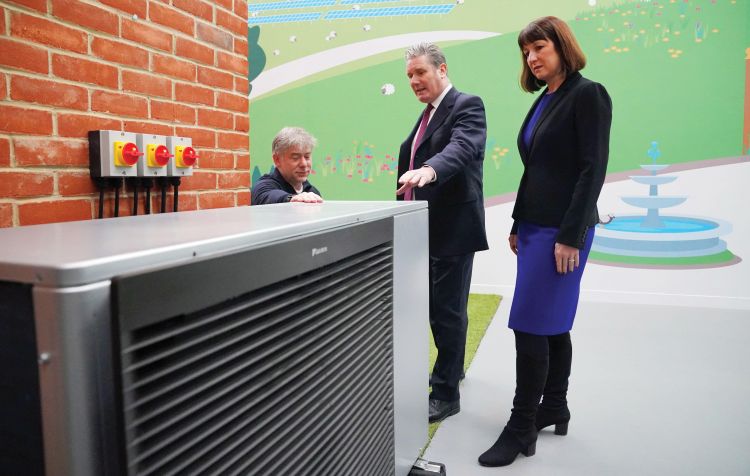
Yet Jackson has not managed to convince the new government on his most controversial ask: zonal energy pricing. He argues that Octopus would be able to cut energy bills by £100 a year if the switch were made to a system whereby prices varied across regional zones in the country, depending on their supply and demand. The proposal was shot down by other major operators on the grounds that it would create a “postcode lottery” for energy.
Miliband considered the policy before ultimately dropping it over fears it could put off investors. The defeat marked a victory for Centrica, the owner of British Gas and chief rival of Octopus.
With success came critics, who are capitalising on recent problems – including Ofgem’s anonymised rebuke of companies for failing financial resilience targets. Jackson, who admits Octopus was one of the firms that failed the test, argues the requirements are too stringent. Centrica’s CEO Chris O’Shea described it as “criminal” that Ofgem had not punished firms like Octopus further.
Jackson’s portrayal of rival energy companies is compelling – he paints them as a cartel, cautiously protecting margins at the expense of consumers. “One of them texted us to say they had 150 lobbyists up against us,” Jackson says of the zonal pricing spat. “We have two on our side.”
While he only has two lobbyists, Jackson in himself has the executive lobbyists are scared to represent. One tells The House: “You never want to represent someone who knows all the decision-makers better than you.”