

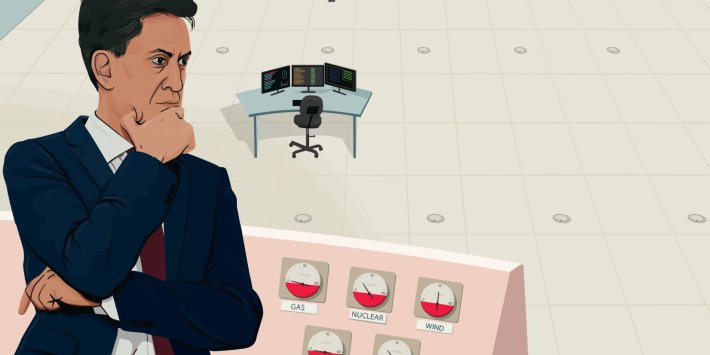
Illustration by Tracy Worrall

11 min read
The success of the latest wind power auction has put Ed Miliband within sight of realising the goal of decarbonising the UK’s electricity network by 2030. But, as Adam Bell reports, daunting obstacles remain – and any success may be bittersweet
It is almost midnight on 31 December 2029, deep in the bowels of Whitehall. A room where monitors bedeck every surface is filled with officials scurrying to and fro. A bespectacled man is on the phone, pinching the brow of his nose in frustration.
“…I know, I know, I know. Inertia. Just please turn it off for the next half hour, and spin up a battery instead.”
He puts down the phone with a heavy sigh. “TEN SECONDS TO MIDNIGHT,” yells one of his staff.
All eyes turn to the screen, where a bar labelled “GAS” is starting to shrink.
“FIVE.” The bar is now halfway down.
“FOUR.”
“THREE.”
“TWO.”
“ONE.”
The bar falls to zero. The room erupts. The lights stay on.
The government is building an enormous machine. It could already raise the temperature of the North Sea, albeit by a single degree and in 200 years. But by 2030, it hopes to have upgraded the machine to such an extent that it would take a mere 150 years.
This machine is the electricity system, and it touches every part of our isles. It is, by a substantial margin, our most complex device. It is in every home, every office and every factory, and it connects them together through a web of cabling that is now well over a century old. While the individual wires may have been replaced, the circuit endures.
The original point of building such a vast machine was to manage the reality that our demand for electricity is not a flat line but varies continuously throughout the day. But the more people connected to a circuit, the more their varied times of switching on the kettle even out. This allows fossil fuel generators to run much more efficiently. Constantly switching them on and off takes more fuel, and instead being able to gently ramp them up and down over the course of the day made electricity considerably cheaper.
Labour won the last election in part through a promise to cut bills by £300 by weaning the country off gas. Its plan for doing so is to decarbonise power by 2030 and thus ensure that the energy crisis, prompted by Russia’s invasion of Ukraine, can never happen again. The public face of this plan is Ed Miliband, and his political future is tightly tied to its success. As part of this, he has given considerable new powers to the National Energy System Operator, the body responsible for both balancing the minute-to-minute operation of the grid and now planning its upgrade.
This is not an easy task. Power plants that run on sunbeams do not have the same performance characteristics as plants that run on gas. You can’t switch the Sun on and off, and indeed in the UK the weather will frequently switch the Sun on and off for you. This means that renewable power plants can’t respond to demand. So, to replace gas, you must not simply build solar panels and wind turbines but all the infrastructure necessary to ensure that demand can be satisfied. And then you must ensure that you can actually make that infrastructure run smoothly.
Nuclear power helps out in part but suffers from almost the opposite problem to renewables: it is very hard to switch off. You can change its output at the margins, but demanding that it have the same performance characteristics as a gas plant will lead to a nuclear engineer saying terrifying things like, “Well, I suppose we could poison the reactor with xenon.”
Nonetheless, having a nuclear backbone helps. In 2025, always-on demand equated to about 13m kettles all boiling at once. Most of the UK’s nuclear reactors are older gas-cooled designs. The last of these came online in 1988. They are now ageing and will need to come offline for decommissioning.
By 2030, it is likely that only one of those reactors will remain online, alongside the 1990s vintage reactor at Sizewell in Suffolk. The only nuclear power plant currently being constructed in the UK, at Hinkley in Somerset, consists of two very large reactors, one of which has the potential to be online by 2030. Without this last reactor, the 2030 target will be in trouble, and considerable effort is going into making sure it happens.
However, while nuclear can take care of our 13m kettles, at maximum the UK consumes power equivalent to 60m kettles. This means there is a very large volume of variable demand to solve. As above, we can’t do this with wind and solar alone. We need ways to store their power and ensure it can get to where it needs to go. But even with that, we’ll still need a lot more wind and solar. The government’s task here is to make that happen.
To put this into perspective, we currently have 16GW of offshore wind around our coasts. You don’t need to know what a gigawatt is to know that adding at least 28 more is a lot. Luckily there’s enough already in process to mean that the government is likely to only need to buy 16-20 extra gigawatts. In its most recent round of renewables purchases it was able to buy 8.4 of this total, putting it within striking distance of hitting its target.
But the problem government now faces is that the price it paid for offshore wind in this round was higher than it has paid for other recent rounds, and developers now know that it’s willing to pay over the odds to hit its target. This implies that if it wants to buy the same amount in the next round it might be charged even more. At the same time, the US’ current antipathy towards wind projects in its own waters will prompt developers to pivot away towards Europe and Asia, potentially improving competition.
The same challenge applies to onshore wind and solar. Onshore wind needs to double, and solar needs to triple. In February we will find out how much government has paid to bring more of these projects online. But the big problem these projects face is much less getting paid and much more about getting connected.
Where pylons stride across landscape, local opponents could cause delay, whether by judicial reviews or planning inquiries
The wires that run the length of the country, the high voltage highways of the power system, were built when most of our power stations were located in the middle of the country and the task was to get the power from the middle to the edge. But the windiest parts of the UK are in Scotland, and the sunniest parts are in Cornwall, which means we now need to rewire the country to bring power from the edges into the middle. Given that our existing grid was slowly built out over the course of about a century, rewiring everything everywhere all at once is a colossal challenge by itself.
It will involve building about 1,000 kilometres of wire onshore and about 4,500 kilometres of wire offshore. The onshore cables will carried by pylons, aside from a small number of locations where they will be buried in the ground to protect nationally significant landscapes. The offshore cables will take the form of enormous wires stretching through the North Sea from Scotland to the Midlands, ensuring that wind can get out of Scotland efficiently, as well as new offshore connections around East Anglia.
Whether onshore or offshore, these projects will face opposition. Where pylons stride across landscape, local opponents could cause delay, whether by judicial reviews or planning inquiries. Offshore cables are not immune because bringing high-voltage direct current connections onshore means very large converter stations. To the uninitiated, these resemble large coastal warehouses – and those who live near them have already started to organise.
Without sufficient connectivity, adding more wind farms will not actually reduce emissions: even if England buys their power, if the power can’t physically get to England, gas power stations will need to be switched on to meet demand.
But because if you’ve sold your power you still get paid regardless of whether it can get to your customer or not, lots of applications for wind, solar and battery projects have been put in across the country. Not all of those can efficiently connect to the grid. Historically, new grid connections have been managed on the basis of first-come first-serve, but in a context in which literally hundreds of gigawatts’ worth of projects had applied for a connection, something new was required.
The System Operator has, therefore, decided to stop allocating connections based on who happened to have bought an option on farmland in Yorkshire and applied on the never-never six years ago, and instead moved to a much more centrally directed regime. Quite simply, it’s looked at all the regions of the UK, looked at how much connectivity it has to play with, and said, “Alright, we need more solar here, some batteries there, and a few wind turbines over here.” It’s then allocated grid connections on this basis and stripped out all those applications from people who hadn’t even bothered to get planning permission.
Batteries and solar – and projects with solar and batteries on the same site – have been the big winners from this process, even if a lot of more speculative applications for these technologies have fallen by the wayside. Lithium-ion batteries, typically made in China but controlled by British-designed software, are expected to come into their own for the purposes of 2030. They will be increasing fivefold from their current capacity of 5GW to closer to 25GW. This moves them from an interesting technology project into the daily mainstay of the grid, storing the midday sun and pumping it out at teatime.
But this new approach to grid connections relies on the wires that provide that connectivity actually being built on time, and here the picture is not quite as positive. The Norwich to Tilbury line, essential for conveying as much offshore wind to the South East as possible, has been delayed to 2031. Without it, the volume of low carbon power that can reach demand will be lower.
Delays are a function of both engineering challenges and financial engineering challenges. In building all of this new grid infrastructure, the transmission companies can only spend up to the amount that Ofgem has allowed them to, before it starts cutting into their bottom line. Ofgem has not allowed the network companies to spend everything they might need for 2030 yet. They have taken the not-unreasonable view that all the generation needed might not materialise, and if it doesn’t materialise then the wires aren’t needed. The spending is therefore locked up inside Uncertainty Mechanisms, a term of regulatory art that doesn’t refer to a mechanical magic 8-ball but rather to a set of conditions under which the money will be unlocked. Which includes progress on delivering all the renewables projects laid out above.
The government’s problems don’t end there. While gas will only provide about five per cent of the electricity needed to run the system, actual gas plants will need to run 20-30 per cent of the time. But much like the nuclear fleet, our gas fleet is ageing and it’s not clear whether many of the existing plants will stagger over the finish line.
The government currently plans to carve out a special market for new build and refurbished gas plant – but, much like with offshore wind, the market knows that these plants are needed and will extract as much value as it can.
These are strong headwinds, but there is an unexpected chink of light. The government may be on course to achieve its 2030 target, albeit not in the way it expected. Many of the large numbers set out above presume significant increases in demand. If demand doesn’t increase dramatically – driven by heat pumps, electric cars and data centres – then a smaller generation build-out might be sufficient to decarbonise the power system. Given that demand for electricity has been declining for the last 20 years, this would be in keeping with the existing trend.
This may be excellent for the target, but this chink of light would in fact be the lights of an oncoming train of failure for the government’s other objectives. Progress on decarbonising heat and transport – not to mention progress on rolling out the data centres necessary for AI – will have gone seriously off-track.
The government’s Warm Homes Plan calls for 200,000 fewer heat pumps than the Climate Change Committee’s target. The Treasury has decided to levy a similar tax on electric vehicles that, when imposed in New Zealand, saw deployment fall by half. The newspapers are full of claims that AI is a bubble.
The triumphant crossing of the finishing line at the end of the decade may yet be realised – but the way we got there may mean it doesn’t feel that great.